
As an Amazon Associate I earn from qualifying purchases.
If you have decided to buy your first serger, you have probably already narrowed it down to these two. The Brother 1034D and the Singer ProFinish 14CG754 are the two best-selling beginner sergers in America, they cost roughly the same, they sew at the same speed, and every “best serger” list puts them at the top. So which one actually deserves your money?
The short version: they are 90% the same machine in different clothes. The 10% that differs comes down to one feature, 2-thread stitching, and one intangible, fifteen years of tutorial support. This comparison walks through both, honestly, so you can stop researching and start sewing.
TL;DR: Buy the Brother 1034D (~$290–$330) if you want the most supported beginner serger ever sold, with the easiest threading system and a tutorial for every problem you will ever have. Buy the Singer ProFinish 14CG754 (~$200–$280) if you want 2-thread stitching for fine fabrics and rolled hems, or if it is notably cheaper on the day you shop. For most beginners sewing medium-weight knits and wovens, the Brother is the safer pick. For garment sewers working with delicates, the Singer’s 2-thread capability is the deciding feature.
At a Glance, Our Scores
| Pick | Best for | Our score | Typical price | |
|---|---|---|---|---|
| Brother 1034D | Easiest learning curve, maximum support | 9.2/10, the default beginner serger for 15+ years | ~$290–$330 | Check Price on Amazon |
| Singer ProFinish 14CG754 | 2-thread stitching, lower price | 8.7/10, the smarter buy when it is $50+ cheaper | ~$200–$280 | Check Price on Amazon |
Prices move constantly on Amazon, every “Check Price on Amazon” link below takes you to the live listing.
Detailed Reviews
1. Brother 1034D
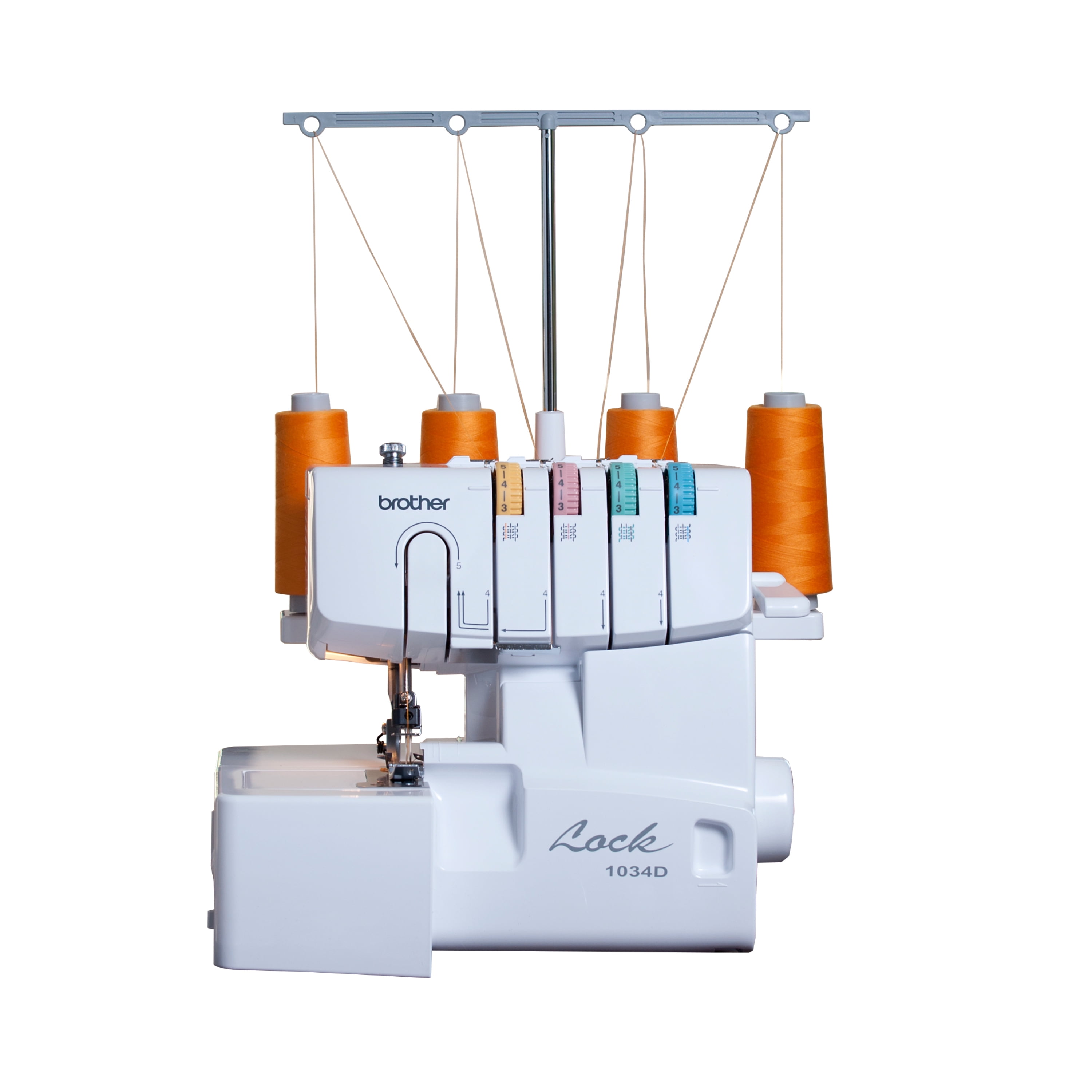
The 1034D is a 3/4 thread serger sewing up to 1,300 stitches per minute, with 22 stitch functions, differential feed, and Brother’s color-coded lay-in threading system. The metal frame keeps it stable, the LED work light is adequate, and the trim trap catches the fabric strips the knives cut off. Brother covers it with a limited warranty and free phone support for the life of the machine.
What you are really buying is the ecosystem. Because this machine has been the default recommendation since the late 2000s, every threading problem, tension issue, and fabric-specific question has been answered dozens of times on YouTube, Reddit, and sewing forums. When your lower looper thread keeps breaking at 11pm, someone has filmed the exact fix. No other beginner serger offers that safety net.
The limitation is thread count. With 3/4 thread only, you cannot do true 2-thread stitches, which means narrower rolled hems and the lightest edge finishes are out of reach. For most beginners sewing t-shirts, leggings, and quilting cotton, this never comes up. It comes up when you start sewing chiffon, silk, or very fine knits.
Good
✓ Easiest threading in the class, color-coded lay-in loopers
✓ Unmatched tutorial library, fifteen years of community answers
✓ 1,300 SPM, differential feed, 22 stitch functions, metal frame
✓ Free lifetime phone support from Brother
Watch out for
✕ No 2-thread stitching, the Singer’s main advantage
✕ Usually the pricier of the two, ~$290–$330 street
✕ Trim trap is small, empty it during long sessions
✕ No free arm, the Singer has one (optional)
Bottom line: The serger equivalent of a Toyota Corolla. Not exciting, almost impossible to regret.
2. Singer ProFinish 14CG754

The ProFinish is a 2/3/4 thread serger, also sewing up to 1,300 stitches per minute, with differential feed, adjustable stitch length and width, LED lighting, and six stitch types covering seams, blind hems, rolled hems, and flatlocking. It has an optional free arm for sewing cuffs and sleeves in the round, and Singer backs it with a 25-year limited warranty.
The 2-thread capability is the whole argument. Two-thread overlock gives you a narrower, flatter seam finish, and two-thread rolled hems are the proper way to finish sheer and lightweight fabrics. If your sewing plans include a lot of delicate material, this is not a minor feature, it is the reason to buy this machine over the Brother.
The trade-off is support depth. Threading is color-coded and perfectly manageable, but owners describe it as slightly fussier than the Brother’s lay-in system, and the online tutorial library is a fraction of the size. Tension adjustments need a bit more attention when you change fabric weights. None of this stops anyone from learning, it just means slightly more self-reliance in the first month.
Good
✓ 2/3/4 thread, the 2-thread stitches the Brother cannot do
✓ Often $50–$100 less than the 1034D
✓ 1,300 SPM, differential feed, 6 stitch types, adjustable length and width
✓ Optional free arm, 25-year limited warranty
Watch out for
✕ Threading is good but not quite as foolproof as the Brother
✕ Much smaller tutorial and forum ecosystem
✕ Tension dials need more fiddling between fabric types
✕ Build feels slightly less solid than the Brother
Bottom line: Buy it for the 2-thread stitching or the lower price. Both are legitimate reasons.
Head-to-Head: The Differences That Matter
Threading: Brother wins
This is the most important category for a beginner, and the Brother takes it. Its lay-in looper threading, where you lay the thread into guides rather than fishing it through tiny holes, combined with color-coded paths printed on the machine, makes the first threading session meaningfully less painful. The Singer is color-coded too and perfectly learnable, but owners consistently describe it as requiring a bit more patience. Add the Brother’s enormous tutorial library, and a stuck beginner gets unstuck faster on the 1034D.
Stitch capability: Singer wins
The Singer’s 2/3/4 thread range beats the Brother’s 3/4, full stop. Two-thread overlock and two-thread rolled hems are genuinely useful for lightweight and sheer fabrics, and there is no workaround on the Brother. If you know you will sew delicates, this category alone decides the comparison. If you will not, it is a paper advantage.
Speed and feed: Tie
Both sew up to 1,300 SPM. Both have differential feed. Both handle knits and wovens well within a beginner’s needs. There is no meaningful performance gap here, anyone telling you otherwise is splitting hairs.
Build and reliability: Brother, slightly
Both have metal frames and multi-decade brand support. The Brother’s fifteen-year production run means every weak point has been found and fixed; the Singer is well-built but does not have the same track record of longevity data. Owner ratings for both sit in the mid-4s, which tells you neither is a lemon.
Price: Singer, usually
The ProFinish typically streets at ~$200–$280 against the Brother’s ~$290–$330. That $50–$100 gap is real money in a beginner budget, and it buys a lot of serger thread. That said, both fluctuate, and on sale days the gap narrows. Check both listings before deciding.
Support and community: Brother, by a mile
Fifteen years as the default recommendation created an unmatched support ecosystem: thousands of YouTube tutorials, forum threads for every error, and easy parts availability. The Singer has decent support, but it is not close. For a nervous beginner, this matters more than any spec.
Side-by-Side Comparison
| Brother 1034D | Singer ProFinish 14CG754 | |
|---|---|---|
| Thread capability | 3/4 thread | 2/3/4 thread |
| Stitch functions | 22 | 6 stitch types |
| Max speed | 1,300 SPM | 1,300 SPM |
| Differential feed | Yes | Yes |
| Threading | Color-coded lay-in | Color-coded |
| Rolled hem | Yes | Yes (including 2-thread) |
| Free arm | No | Optional |
| Lighting | LED | LED |
| Weight | ~17 lbs | ~13.5 lbs |
| Warranty | Limited + lifetime phone support | 25-year limited |
| Typical price | ~$290–$330 | ~$200–$280 |
| Check Price on Amazon | Check Price on Amazon |
Prices fluctuate frequently on Amazon; click through for the current price.
The Threading Experience, Step by Step
Since threading is the number one fear, here is what it actually looks like on each machine, based on owner reports.
On the Brother 1034D: open the front cover, and the thread path is printed on the machine in four colors. You lay each thread into its color-coded guides, the lower looper uses a lay-in slot rather than a threading hole, and the whole process follows the printed numbers 1 through 4. First-timers report 30–45 minutes with the manual. By the fifth threading, most people do it in under five minutes. The trick experienced owners share: when changing thread colors, tie the new thread to the old thread and pull it through, which avoids rethreading entirely.
On the Singer ProFinish 14CG754: the process is similar in concept, color-coded guides, numbered paths, but the looper threading requires a bit more dexterity, and owners say the manual’s diagrams are slightly less clear than Brother’s. First-timers report 45–60 minutes. The same tie-on trick works here and is just as valuable. Once learned, threading time is comparable to the Brother, the difference is almost entirely in the learning curve, not the ongoing experience.
The takeaway: the Brother gets you through the painful first month faster. After three months, owners of both machines thread without thinking about it.
Which Should You Buy?
Buy the Brother 1034D if: you are a nervous beginner who wants maximum hand-holding, you sew mostly medium-weight knits and wovens, you value the tutorial ecosystem, or the price gap is small on the day you shop. This is the right choice for most first-time serger buyers.
Buy the Singer ProFinish 14CG754 if: you sew lightweight or sheer fabrics where 2-thread stitching matters, you want the free arm for cuffs and sleeves, or it is $50+ cheaper than the Brother when you are ready to buy. The savings are real and the machine is genuinely capable.
Either way, avoid this mistake: do not buy a $150 no-name serger thinking you are being clever. Sergers have precise timing and loopers that need to stay true; when a cheap one drifts, there are no parts and no one to call. Both of these machines come from companies that will still sell parts in ten years.
Owning It: Maintenance, Accessories, and Thread
Maintenance is simple but not optional. Sergers generate enormous amounts of lint, the knives shave fabric with every stitch, and that lint packs into the looper area. Brush it out after every few projects, oil the marked points every month or two of regular use, and change needles often, serger needles dull faster than sewing machine needles because of the speed. Neither machine needs professional servicing in its first years unless the timing slips, which is rare without an impact or a jam forced through.
Accessories worth buying: a good pair of serger tweezers (the included ones are adequate, not great), extra needles in the sizes you use most, and a cone thread stand if your thread cones do not fit the machine’s holders. A rolled hem foot comes standard on both, but a gathering foot and an elastic foot expand what you can do, usually $12–$20 each.
Thread budget is real. A serger uses 3–4 cones per project, and you will want black, white, navy, and gray at minimum, plus colors for specific projects. Budget $30–$50 for a starter thread stash. Maxi-Lock and similar serger threads are the standard recommendation, and they are inexpensive per cone, which softens the blow.
How We Compared
We did not unbox these sergers side by side in a lab, and we won’t pretend we did. Instead, we cross-referenced manufacturer specifications against live retailer listings, read thousands of verified owner reviews for both machines looking for failure patterns rather than star counts, and compared them on the criteria that actually decide a beginner’s experience: threading ease, stitch capability, tutorial availability, and long-term reliability reports. We weighted real owner complaints, tension fussiness, threading difficulty, parts availability, over spec-sheet differences. Prices shown are typical US street bands; Amazon moves them constantly, so confirm at checkout.
Keep Reading
FAQs
Can the Brother 1034D do a rolled hem?
Yes, it does a 3-thread rolled hem, which covers most rolled-hem needs. What it cannot do is a 2-thread rolled hem, which is narrower and better for very sheer fabrics. For that you need the Singer or a 2/3/4 thread machine like the Juki MO-654DE.
Is the Singer ProFinish harder to thread than the Brother?
Slightly, according to owner reports. Both are color-coded, but the Brother’s lay-in looper design is more forgiving, and the Brother has far more video tutorials walking through the process. A patient beginner will manage either one.
Do I need 2-thread stitching as a beginner?
Probably not at first. Two-thread stitches matter for lightweight and sheer fabrics, rolled hems on delicates, and flatlocking details. If your first projects are t-shirts, leggings, and quilting cotton, 3/4 thread covers everything. It becomes relevant as your sewing advances into finer fabrics.
Which one is better for knits?
Both, equally. Knit performance comes down to differential feed, which both machines have, and both sew at 1,300 SPM. Choose based on threading ease, 2-thread need, and price, not knit performance.
Should I just get the Brother 1034DX instead?
The 1034DX is the same machine with extra accessory feet and a cover. If it is within $20 of the 1034D, sure. If the price gap is bigger, the 1034D is the same serger where it counts.
Can either machine do coverstitch?
No. These are overlock sergers only. Coverstitch, the double-needle hem finish on store-bought t-shirts, needs a separate coverstitch machine or a combo machine like the Singer 14T968DC.
Verdict
For most beginners, buy the Brother 1034D. The threading is easier, the tutorial library is unmatched, and fifteen years of owners cannot be wrong.
But if the Singer ProFinish 14CG754 is significantly cheaper when you shop, or you need 2-thread stitching for fine fabrics, buy it with confidence. It is not the consolation prize, it is the right machine for a specific sewer.
The only wrong answer is analysis paralysis. Both machines will still be working in ten years. Pick the one that matches your fabric and your budget, thread it up, and start serging. And when you are ready for the next step, whether that is a coverstitch machine for professional hems or an upgrade to the Juki MO-654DE, you will know exactly what you need, because this machine taught you.
Pingback: Serger vs Sewing Machine: What's the Difference (and Do You Need Both?)