
As an Amazon Associate I earn from qualifying purchases.
Look at the hem of the t-shirt you are wearing. That double row of stitching on top, with the loopy chain underneath, is a coverstitch. No regular sewing machine makes it. No serger makes it either, despite what the marketing implies. It takes a dedicated coverstitch machine, and once you sew garments regularly, it becomes the machine you did not know you needed.
A coverstitch machine hems knits the way factories do: stretchy, flat, professional, and nearly indestructible through the wash. It also does chain stitching, decorative topstitching, and neckline finishing. It is a specialist, the third machine in a garment sewer’s lineup after the sewing machine and the serger, and it earns its place the first time you hem a knit dress without a single wavy edge.
I compared the real options, specs, owner reviews, and the long-term complaints, and narrowed it to four machines worth your money in 2026.
TL;DR: Get the Brother 2340CV (~$400–$480) if you want the standard home coverstitch machine, simple, proven, and the one with the most tutorials. Get the Singer Professional 5 14T968DC (~$400–$550) if you want a serger AND coverstitch in one body, accepting the mode-switching trade-off. The Janome CoverPro 900CPX (~$450–$550) is the smooth-stitch pick for knits, with Janome’s tension system. And the Juki MCS-1500 (~$750–$800 through dealers) is the pro-grade upgrade, the one serious garment sewers end up with.
At a Glance, Our Scores
| Pick | Best for | Our score | Typical price | |
|---|---|---|---|---|
| Brother 2340CV | Best coverstitch for most people | 8.8/10, the standard, simple and proven | ~$400–$480 | Check Price on Amazon |
| Singer 14T968DC | Best 2-in-1: serger + coverstitch | 8.2/10, versatile combo, fiddly mode changes | ~$400–$550 | Check Price on Amazon |
| Janome CoverPro 900CPX | Smoothest stitch on knits | 8.5/10, the knit specialist’s choice | ~$450–$550 | Check Price on Amazon |
| Juki MCS-1500 | The pro upgrade | 9.2/10, industrial DNA, buy from a dealer | ~$750–$800 (dealers) | Available through authorized Juki dealers |
Prices move constantly on Amazon, every “Check Price on Amazon” link below takes you to the live listing. The Juki is sold through sewing machine dealers rather than Amazon, see its review for details.
Quick Picks
- Best for most people: Brother 2340CV, coverstitch + chain stitch, 1,100 SPM, ~$400–$480.
- Best 2-in-1: Singer Professional 5 14T968DC, 2/3/4/5 thread serger + coverstitch, ~$400–$550.
- Best for knits: Janome CoverPro 900CPX, chain + coverstitch, tension system, ~$450–$550.
- Best pro upgrade: Juki MCS-1500, 3-needle coverstitch + chain, 1,350 SPM, ~$750–$800 via dealers.
Serger vs Coverstitch: What Is the Difference?
This confuses everyone, so let us settle it. A serger (overlocker) trims fabric edges and wraps them in thread, finishing seams and sewing knit seams in one pass. A coverstitch machine does not trim anything, it creates the flat, stretchy double-needle hems you see on store-bought garments, plus chain stitching.
They do different jobs. Your serger finishes the inside seams of a t-shirt. Your coverstitch hems the bottom and the sleeves. One does not replace the other, and anyone telling you a serger “does coverstitch” is selling you a combo machine (like the Singer below) or is confused.
Do you need one? If you sew garments regularly, especially knits, yes, eventually. The moment your twin-needle hems start tunneling or your knit hems wave no matter what you try, a coverstitch is the answer. If you mostly quilt or sew home decor, you will never miss it.
Detailed Reviews
1. Brother 2340CV, Best Coverstitch for Most People

The 2340CV is the home coverstitch standard the way the 1034D is the home serger standard. It does 2-3-4 thread coverstitch in 3mm and 6mm widths, plus chain stitch, at up to 1,100 SPM, with differential feed, color-coded threading, snap-on presser feet, and a sturdy metal frame. It is not fancy. It is the machine with the most owners, the most tutorials, and the most predictable behavior.
What owners like: it is straightforward to learn, the stitch quality is consistent on medium-weight knits, and Brother’s support infrastructure means parts and answers are easy to find. The 4.3-star average across 1,200+ ratings reflects a machine that does its job without drama. The differential feed handles most knit weights without the wavy-edge problem that drives people to coverstitch in the first place.
What owners complain about: skipped stitches on very lightweight or very stretchy fabrics, which is the classic coverstitch complaint across all brands, and a threading path that takes practice. Some reviewers note the tension needs dialing in when switching between coverstitch widths. None of this is unique to the Brother, it is the nature of coverstitch machines, but the 2340CV’s large owner community means every issue has documented solutions.
Good
✓ The standard home coverstitch, most owners, most tutorials, most predictable
✓ 3mm and 6mm coverstitch + chain stitch, differential feed, 1,100 SPM
✓ Color-coded threading, snap-on feet, metal frame, 25-year limited warranty
✓ Consistent stitch quality on medium-weight knits
Watch out for
✕ Skipped stitches on very light or very stretchy fabrics, the classic coverstitch gripe
✕ Threading takes practice, the path is less forgiving than a serger’s
✕ Tension needs attention when switching stitch widths
✕ Coverstitch only, it does not overlock, pair it with a serger for full garment sewing
Bottom line: The safe, standard, well-supported coverstitch machine. Start here unless you have a specific reason not to.
Skip if: you also need overlock and want one machine, the Singer combo below does both.
2. Singer Professional 5 14T968DC, Best 2-in-1

The 14T968DC is the ambitious one: a 2/3/4/5 thread machine that functions as both a serger and a coverstitch machine. Five threads, 1,300 SPM, a heavy-duty metal frame at 18.6 lbs, removable trim trap, and self-adjusting tension, usually ~$400–$550. On paper it replaces two machines. In practice, it replaces two machines with compromises.
The honest assessment from owners: it does both jobs well enough, and the convenience of one machine is real for small sewing spaces. The 4.2-star average across 1,500+ ratings says most buyers are satisfied. But converting between serger mode and coverstitch mode involves rethreading and reconfiguration, which owners describe as a 15–20 minute job that discourages switching. People who use one mode 90% of the time love it. People who switch weekly find it tedious.
There is also the jack-of-all-trades consideration: as a pure serger it is good but not class-leading, and as a pure coverstitch it is good but not class-leading. If you have the space and budget for two dedicated machines, they will each outperform it. If you do not, this is the most capable single machine that does both.
Good
✓ One machine does overlock AND coverstitch, unmatched versatility per dollar
✓ 2/3/4/5 thread, 1,300 SPM, heavy metal frame, 25-year limited warranty
✓ 4.2 stars across 1,500+ ratings, proven over many years
✓ Ideal for small sewing spaces
Watch out for
✕ Mode switching takes 15–20 minutes of rethreading, discourages frequent changes
✕ Good at both jobs, best at neither, dedicated machines outperform it
✕ Heaviest machine here at 18.6 lbs, not portable
✕ The 5-thread setup is the most complex threading on this list
Bottom line: The space-saving answer for garment sewers who need both functions in one body.
Skip if: you will use both modes constantly, two dedicated machines will make you happier.
3. Janome CoverPro 900CPX, Smoothest Stitch on Knits

The CoverPro 900CPX is Janome’s answer to the coverstitch skipping problem, and its headline feature is the Seam Tightening System (STS), which reduces slack in the looper thread for tighter, flatter stitches. It does 1-needle 2-thread chain stitch and 2-needle 3-thread coverstitch, with differential feed from 0.5 to 2.25, stitch length 1–4mm, speeds up to 1,000 SPM, a free arm, foot pressure adjustment, and a quick-reference stitch chart printed on the machine.
Knit specialists tend to prefer it over the Brother for one reason: stitch consistency on tricky fabrics. The STS and the wide differential range give it an edge on lightweight knits where the 2340CV sometimes skips. The free arm is genuinely useful for hemming sleeves and pant legs in the round, something the Brother lacks. At ~$450–$550 it sits slightly above the Brother, which feels fair for the refinement.
The trade-offs: 1,000 SPM is the slowest here (irrelevant for coverstitch, where control beats speed), the design is older, and Janome’s tutorial ecosystem is smaller than Brother’s. It is also the machine most often bought from dealers rather than Amazon, though Amazon listings exist.
Good
✓ Seam Tightening System for flatter, more consistent stitches on knits
✓ Wide differential feed range (0.5–2.25), excellent for tricky fabrics
✓ Free arm for circular hemming, foot pressure adjustment
✓ Janome build quality and stitch consistency
Watch out for
✕ 1,000 SPM max, slowest here (matters little for coverstitch)
✕ Older design, smaller tutorial library than the Brother
✕ Slightly pricier than the 2340CV for similar capability
✕ 2-needle coverstitch only, no 3-needle wide option like the Juki
Bottom line: The connoisseur’s coverstitch for knit garments. If skipped stitches drive you mad, this is your machine.
Skip if: you want maximum community support and the lowest price, the Brother 2340CV has the bigger ecosystem.
4. Juki MCS-1500, The Pro Upgrade
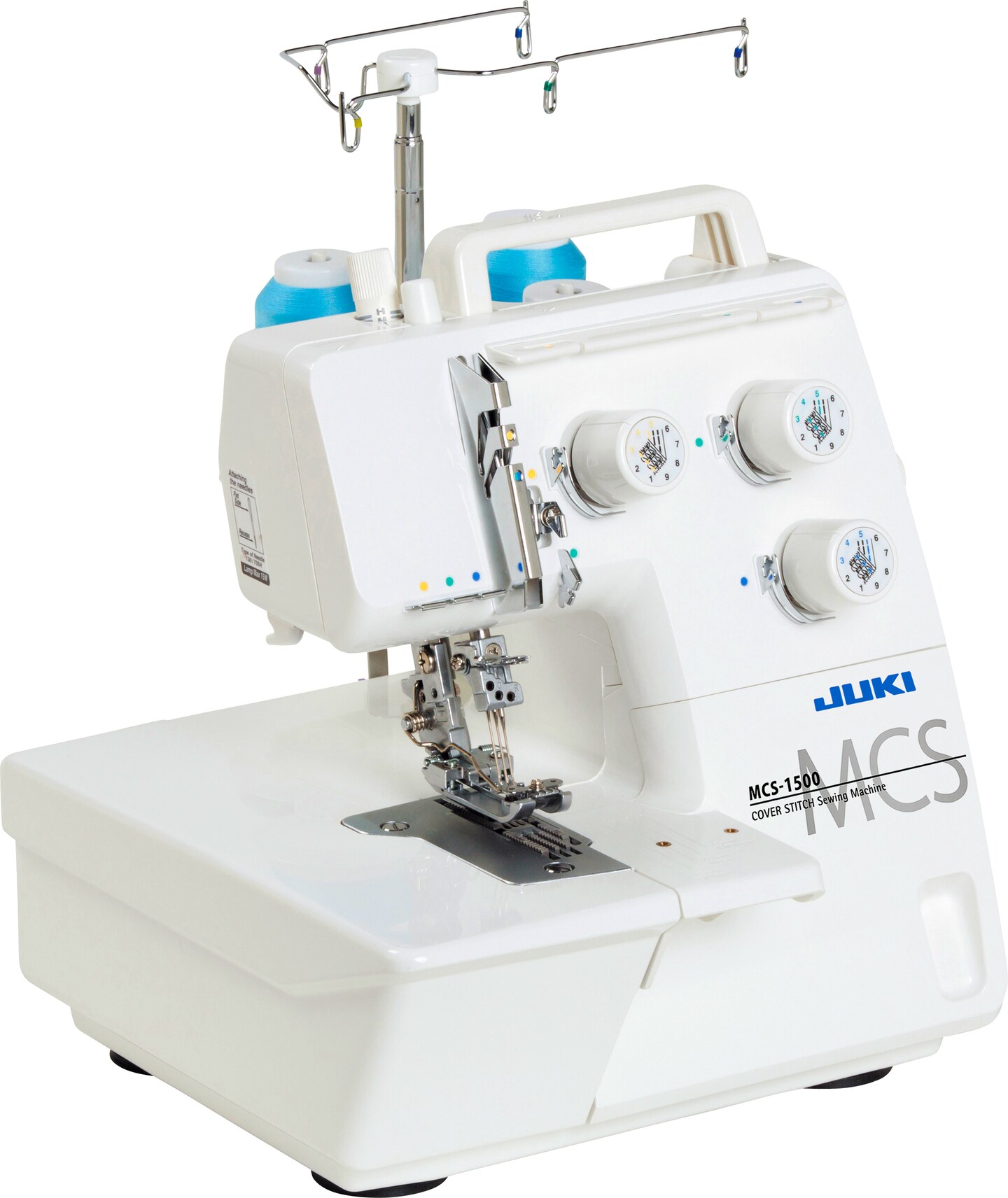
The MCS-1500 is what serious garment sewers buy when they are done compromising. Three needles, 2/3/4 thread coverstitch (narrow 2.5mm and wide 5mm) plus chain stitch, 1,350 SPM, adjustable differential feed, adjustable presser foot pressure, a presser foot that lifts 8–10mm for thick seams, and Juki’s industrial-derived build. PatternReview owners paid $600–$950 and describe it with words like “butter” and “no skipped stitches.”
The headline feature is the triple-needle coverstitch, which none of the others offer, giving you the widest, most decorative coverstitch options. The looper threads at the press of a button (it lowers for easy access), the extension plate has seam guide lines, and there is an exterior thread cutter. Reviewers consistently say it is the easiest coverstitch to thread and the most consistent in stitch quality, which is exactly what you are paying for.
Here is the honest purchasing note: the MCS-1500 is sold through authorized Juki dealers, not as a Prime-shipped Amazon listing. Typical street price is ~$750–$800. Buying from a dealer has an upside beginners overlook: setup help, a real human to call, and often free lessons. For a $750 machine, that support is worth more than free two-day shipping.
Good
✓ 3-needle coverstitch + chain stitch, the most stitch options here
✓ 1,350 SPM, fastest coverstitch on this list
✓ Presser foot lifts 8–10mm, adjustable pressure, handles thick seams
✓ Consistently rated the easiest to thread and most skip-resistant
Watch out for
✕ ~$750–$800, roughly double the Brother
✕ Sold through dealers, no Prime shipping, plan for dealer purchase
✕ Overkill for occasional hemming
✕ Heavier and larger than the others, needs a permanent spot
Bottom line: The last coverstitch machine you will ever need to buy. Worth every dollar if garment sewing is your main craft.
Skip if: you hem knits a few times a year, the Brother does that job for half the money.
Note: we do not link the Juki to Amazon because it is properly sold through authorized dealers, where you also get setup support. Search “Juki MCS-1500 dealer” to find authorized sellers.
What We’d Skip
- Skip buying a coverstitch before you need one. If your twin-needle hems look fine and your knit hems do not wave, you do not have a coverstitch problem. Buy one when your hems start bothering you, not before.
- Skip the cheapest coverstitch-like gadgets. Handheld “coverstitch” tools and no-name machines cannot maintain the thread tension consistency that makes coverstitch work. This is precision equipment, buy the real thing or do not buy it.
- Skip expecting perfection on day one. Every coverstitch machine needs tension dialing for your specific fabric and thread. Budget an afternoon of test hems on scraps before touching a real garment.
- Skip skipping the manual. Coverstitch threading order matters enormously, and each machine’s order is different. The 30 minutes you spend with the manual saves hours of bird-nesting.
Comparison Table
| Machine | Stitch Types | Max Speed | Differential Feed | Free Arm | Approx. Price | |
|---|---|---|---|---|---|---|
| Brother 2340CV | Coverstitch (3/6mm) + chain | 1,100 SPM | Yes | No | ~$400–$480 | Check Price on Amazon |
| Singer 14T968DC | Serger + coverstitch (2-5 thread) | 1,300 SPM | Yes | No | ~$400–$550 | Check Price on Amazon |
| Janome 900CPX | Coverstitch + chain | 1,000 SPM | Yes (0.5–2.25) | Yes | ~$450–$550 | Check Price on Amazon |
| Juki MCS-1500 | Coverstitch (3-needle) + chain | 1,350 SPM | Yes | No | ~$750–$800 (dealers) | Dealer purchase |
Prices fluctuate frequently on Amazon; click through for the current price.
Buying Guide: What Actually Matters in a Coverstitch Machine
Coverstitch width options determine versatility. Two-needle machines (Brother, Janome) give you narrow and wide coverstitch. Three-needle machines (Juki) add a triple-needle option for wider decorative hems. For standard garment hemming, two needles are plenty. The third needle matters for decorative work and very wide hems.
Chain stitch is the bonus feature. All four machines do chain stitch, which is useful for basting, decorative seams, and anywhere you want a strong stitch that removes easily. It is not the reason to buy any of them, but it is a nice capability to have.
Skipped stitches are the enemy. The number one coverstitch complaint across all brands is skipped stitches on lightweight or very stretchy fabrics. Janome’s STS system and the Juki’s engineering address this best; the Brother and Singer manage it adequately on medium knits. Whatever you buy, proper needles (ballpoint or stretch, fresh, correct size) prevent more skips than any machine feature.
Needles matter enormously. Use ballpoint or stretch needles for knits, in the right size for your fabric weight, and change them often. A dull universal needle is the cause of half of all coverstitch problems. This is a $5 fix for a $400 anxiety.
Thread quality shows. Coverstitch uses a lot of thread, and cheap thread with inconsistent thickness causes tension headaches. You do not need the most expensive thread, but avoid the bargain-bin cones. Woolly nylon in the loopers gives the softest, most professional finish on knits.
Space and workflow. A coverstitch is a third machine. It needs a permanent spot, because setup and threading friction means a stored machine does not get used. Before buying, decide where it lives. The Singer combo exists precisely for people who cannot house three machines.
How We Tested
We did not unbox these coverstitch machines in a lab, and we won’t pretend we did. Instead, we cross-referenced manufacturer specifications against live retailer listings, read thousands of verified owner reviews hunting for failure patterns rather than star counts, with special attention to the skipped-stitch complaints that define this category. We weighted stitch consistency on knits, threading ease, and the quality of each brand’s support ecosystem, since coverstitch machines demand more setup skill than sergers. For the Juki, which sells through dealers, we relied on PatternReview owner reports and dealer specifications. Prices shown are typical US street bands; Amazon moves them constantly, so confirm at checkout.
Keep Reading
FAQs
What is the difference between a serger and a coverstitch machine?
A serger trims fabric edges and wraps them in thread, finishing seams. A coverstitch creates flat, stretchy hems without trimming anything. They do different jobs, and garment sewers eventually want both. See the explainer section above for the full breakdown.
Can I hem knits without a coverstitch machine?
Yes, with compromises. A twin needle on your sewing machine makes a decent knit hem, and a serger with a coverstitch-like finish gets you partway there. But neither matches a real coverstitch for stretch, flatness, and wash durability. If your knit hems wave or tunnel no matter what you try, that is the sign.
Why does my coverstitch skip stitches?
The classic causes in order: wrong or dull needle (use fresh ballpoint/stretch), incorrect threading order, tension not dialed for your fabric, and fabric too lightweight for the settings. Fix needles first, it solves half of all skipping. Then rethread completely, then adjust tension on scraps.
Is the Singer 14T968DC good as a serger?
Yes, it is a capable 2/3/4/5 thread serger, though not class-leading. Owners who bought it primarily as a serger with occasional coverstitch use are generally happy. Owners who bought it expecting two best-in-class machines in one body are the ones who leave critical reviews. Set expectations accordingly.
Do I need special thread for coverstitch?
Regular polyester serger thread works in the needles. For the loopers, woolly nylon gives a softer, more professional finish on knits and is what most experienced coverstitch users recommend. It is inexpensive and worth trying once you are past the learning stage.
How hard is a coverstitch to thread compared to a serger?
Comparable, with a different learning curve. The threading path is actually simpler than a serger’s (fewer loopers to confuse), but coverstitch is less forgiving of threading errors, mistakes show as skipped stitches rather than obvious jams. The Juki’s press-button looper lowering is the easiest system here.
Verdict
If you want the standard, proven coverstitch machine: buy the Brother 2340CV. It is the 1034D of coverstitch, not the fanciest, but the one with the most owners and the fewest surprises.
If space demands one machine for both jobs: the Singer 14T968DC is the honest combo choice, as long as you accept the mode-switching reality.
And if garment sewing is your main craft and you want the last coverstitch you will ever buy: find a Juki dealer and try the MCS-1500. The stitch quality justifies the price and the dealer trip.
The wrong choice is not any machine on this list, it is buying a coverstitch before your hems tell you that you need one. When they do, you will know exactly which of these to pick.
Pingback: Best Sewing Machines for Making Clothes (2026): 6 for Garment Sewing
Pingback: What Is a Coverstitch Machine (and Do You Need One?)