
As an Amazon Associate I earn from qualifying purchases.
A serger is the machine that makes your homemade clothes look store-bought. It trims the seam allowance, sews the seam, and wraps the raw edge in thread, all in one pass, at speeds your regular sewing machine cannot touch. If you sew garments, especially knits like t-shirts and leggings, a serger changes everything.
But here is the thing nobody tells beginners: the serger itself is not the hard part. Threading it is. Every serger owner remembers their first threading session, hunched over the machine, tweezers in hand, wondering which looper goes where. The machines on this list earned their spots largely because they make that process as painless as possible, with color-coded guides, lay-in threading, and tutorial libraries built up over years.
I dug through specs, owner reviews, and the actual complaints people post after the honeymoon period, and narrowed it down to five sergers that are genuinely worth a beginner’s money in 2026.
TL;DR: Get the Brother 1034D if you want the safest first serger ever sold, 15 years of tutorials, color-coded threading, and a street price around $290–$330. The Singer ProFinish 14CG754 is its closest rival, with 2-thread capability the Brother lacks, usually $200–$280. On a tight budget, the Singer S0230 gives you 2/3/4 thread and a free arm for around $180–$230. Ready to buy once and cry once? The Juki MO-654DE is the step-up machine at ~$549–$599, faster and more solid than anything here.
At a Glance, Our Scores
| Pick | Best for | Our score | Typical price | |
|---|---|---|---|---|
| Brother 1034D | Best overall first serger | 9.2/10, the default answer for a reason, endless tutorials | ~$290–$330 | Check Price on Amazon |
| Singer ProFinish 14CG754 | Closest rival, 2-thread stitching | 8.7/10, the 2-thread edge matters for fine fabrics | ~$200–$280 | Check Price on Amazon |
| Singer S0230 | Best budget pick | 8.3/10, real serger, free arm, lowest price of entry | ~$180–$230 | Check Price on Amazon |
| Juki MO-654DE | The buy-once upgrade | 9.0/10, the machine you graduate to, or skip graduating and start here | ~$549–$599 | Check Price on Amazon |
| Brother 1034DX | Updated 1034D | 8.5/10, same DNA with a few refinements, buy whichever is cheaper | ~$280–$350 | Check Price on Amazon |
Prices move constantly on Amazon, every “Check Price on Amazon” link below takes you to the live listing.
Quick Picks
- Best overall for beginners: Brother 1034D, 3/4 thread, 1,300 SPM, color-coded threading, ~$290–$330.
- Best rival with 2-thread: Singer ProFinish 14CG754, 2/3/4 thread, 1,300 SPM, ~$200–$280.
- Best budget: Singer S0230, 2/3/4 thread, free arm, ~$180–$230.
- Best upgrade: Juki MO-654DE, 2/3/4 thread, 1,500 SPM, built-in rolled hem, ~$549–$599.
- Best updated classic: Brother 1034DX, 3/4 thread, 3 accessory feet, ~$280–$350.
Detailed Reviews
1. Brother 1034D, Best Overall First Serger
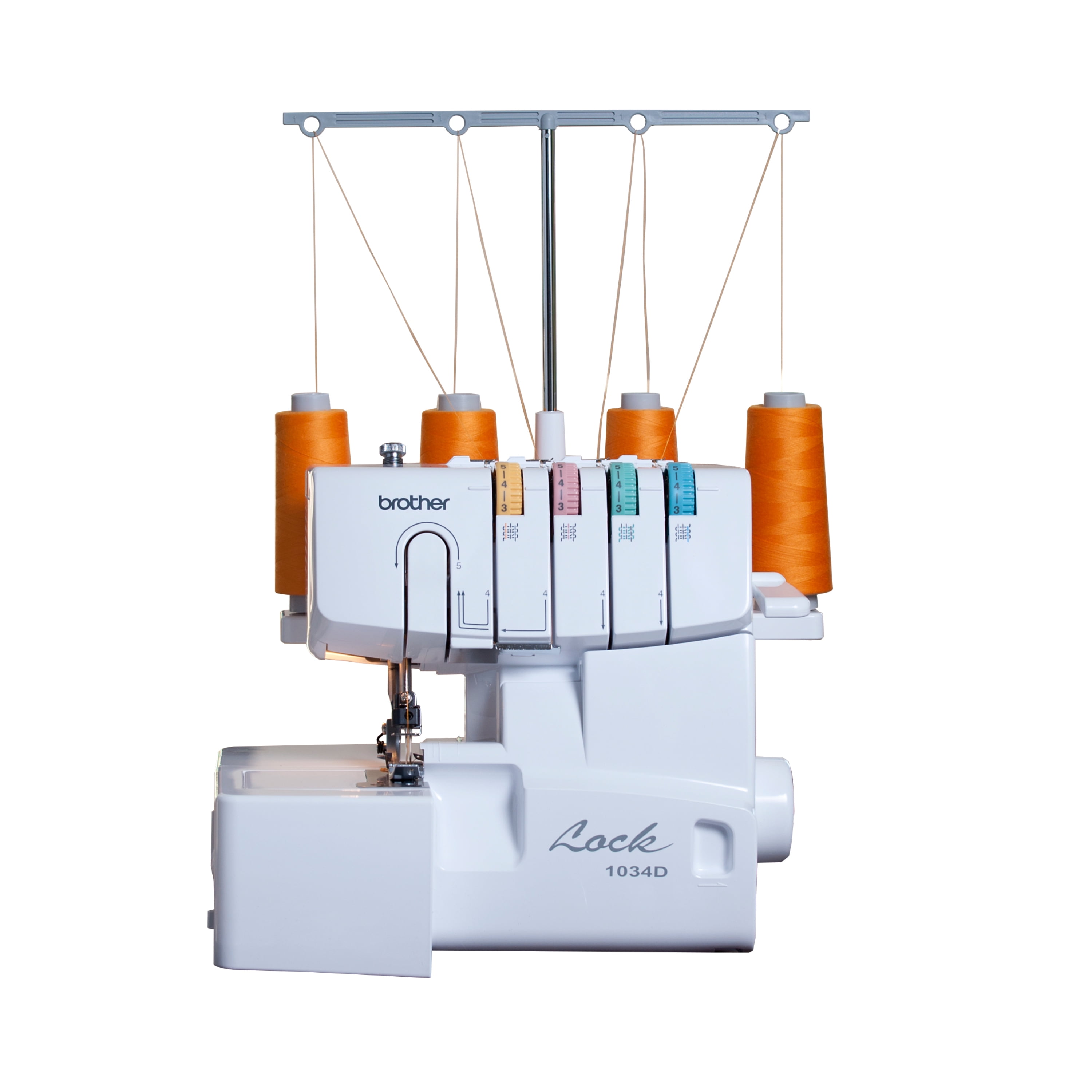
The 1034D has been the default beginner serger recommendation for over fifteen years, and that longevity is the review. When a machine stays in production that long, it means the bugs got worked out a decade ago, every problem you will ever have has been solved on YouTube by someone, and parts will be available for years.
What makes it beginner-friendly is the threading system. Color-coded thread guides are printed right on the machine, the lower looper uses an easy lay-in design instead of the fiddly thread-through-a-tiny-hole arrangement that makes beginners quit, and the included instructional materials actually walk you through it. It handles 3 or 4 threads, sews up to 1,300 stitches per minute, and has 22 stitch functions including a rolled hem option. The differential feed, which is the dial that stops knits from stretching out or puckering, adjusts easily. Brother’s warranty here is 1 year on parts with longer coverage on specific components, plus free phone support for the life of the machine.
The honest caveat: it does not do 2-thread stitching, so very lightweight fabrics and fine rolled hems are slightly out of reach compared to the Singers and the Juki. And at around $290–$330 street price, it is not the cheapest way in anymore.
Good
✓ Color-coded, lay-in threading, the easiest threading system in this price class
✓ Fifteen-plus years of tutorials, manuals, and forum answers for every question
✓ 1,300 SPM, differential feed, 22 stitch functions, metal frame underneath
✓ Free phone support for the life of the machine from Brother
Watch out for
✕ No 2-thread capability, fine fabrics and narrow rolled hems are limited
✕ Not the cheapest option anymore, both Singers undercut it
✕ The trim trap fills fast on big projects, empty it often
✕ Basic accessory set compared to the DX
Bottom line: The safest first serger you can buy. Boring, proven, and supported like nothing else.
Skip if: you specifically need 2-thread stitching for lightweight fabrics, look at the Singer ProFinish or the Juki instead.
2. Singer ProFinish 14CG754, Closest Rival With 2-Thread

The 14CG754 is the Pepsi to the 1034D’s Coke, and the single biggest reason to pick it is the “2” in its 2/3/4 thread capability. Two-thread stitching gives you narrower, lighter seams and a proper rolled hem on delicate fabrics, the kind of finish the Brother simply cannot do. For garment sewers working with chiffon, lightweight knits, or doing a lot of rolled hems, that matters.
Otherwise the spec sheet reads like a mirror of the Brother: 1,300 SPM, differential feed, color-coded threading, adjustable stitch length and width, LED lighting, and six stitch types covering blind hems, rolled hems, flatlocking, and seam finishing. It has an optional free arm for cuffs and sleeves, and Singer’s 25-year limited warranty. Street price usually lands around $200–$280, which undercuts the Brother more often than not.
Where owners complain: the threading, while color-coded, is a touch fussier than the Brother’s lay-in system, and the tutorial ecosystem is smaller. A few reviewers note the tension dials need more fiddling when switching between fabric weights. None of this is disqualifying, it is just the difference between the most-supported machine ever and the runner-up.
Good
✓ 2/3/4 thread capability, the 2-thread stitches the Brother cannot do
✓ Usually $50–$100 cheaper than the 1034D on any given day
✓ 1,300 SPM, differential feed, 6 stitch types, LED light
✓ Free arm option for sleeves and cuffs, 25-year limited warranty
Watch out for
✕ Threading is color-coded but slightly fussier than the Brother’s lay-in system
✕ Smaller tutorial library, fewer forum answers when you get stuck
✕ Tension needs more attention when switching fabric weights
✕ Some owners report a learning curve on the rolled hem setup
Bottom line: The smart buy if 2-thread stitching matters to you, or if it is significantly cheaper than the Brother today.
Skip if: you want the maximum hand-holding and tutorial support, the 1034D’s ecosystem is unmatched.
3. Singer S0230, Best Budget Pick

The S0230 is Singer’s answer to the “I want a real serger but my budget says otherwise” problem. It is a genuine 2/3/4 thread overlock machine with a metal frame, 1,300 SPM, differential feed, color-coded threading, and a free arm, for a street price that hovers around $180–$230. That is the lowest price of entry on this list for a machine from a real brand with a real warranty.
Owner feedback is surprisingly warm for a budget machine. Reviewers consistently mention that it runs quiet, stitches well out of the box, and that threading is straightforward as sergers go. One detailed owner review from someone on their fourth serger called it the machine they now recommend to everyone, praising its out-of-the-box readiness and quiet operation after expensive machines disappointed them.
The trade-offs are what you would expect at this price. The accessory kit is thinner, the overall fit and finish is a step below the 1034D, and long-term durability is less proven since it is a newer model. But as a first serger to learn on, it is honest value.
Good
✓ Lowest price here for a real 2/3/4 thread serger from a major brand
✓ Free arm included, great for sleeves, cuffs, and small projects
✓ Quiet operation, well-reviewed out-of-the-box stitching
✓ Metal frame, 1,300 SPM, differential feed, color-coded threading
Watch out for
✕ Thinner accessory kit than the Brother or ProFinish
✕ Newer model, less long-term durability data than the 1034D
✕ Fit and finish is a step below the premium picks
✕ Fewer dedicated tutorials than the 15-year-old 1034D
Bottom line: The cheapest honest way to find out if serging is for you.
Skip if: you can stretch to the 1034D, the tutorial library and proven longevity are worth the difference for most beginners.
4. Juki MO-654DE, The Buy-Once Upgrade

The MO-654DE is what happens when a company that builds industrial sewing machines makes a home serger. Everything about it feels a half-step more serious than the budget picks: 2/3/4 thread capability, a listed 1,500 SPM (the fastest here), differential feed from 0.7 to 2.0, a built-in rolled hem that needs no plate swapping, and a heavier chassis that stays planted at full speed. Owners on PatternReview and garment-sewing forums describe it as the machine they upgraded to and stopped thinking about.
The 4.5-star average across 1,200+ Amazon ratings backs that up. Reviewers consistently praise the stitch quality, the quiet and stable operation, and the industrial-style tension dials that hold their settings. The color-coded threading is there, though the loopers are manual, no air threading at this price, so your first threading session will still require patience and the tweezers.
At ~$549–$599, it is roughly double the Brother. That is the entire decision: if you already know you will serge regularly, buying this once is cheaper than buying the Brother and then this. If you are not sure, the cheaper machines are the lower-risk experiment.
Good
✓ 2/3/4 thread, 1,500 SPM, the most capable machine on this list
✓ Built-in rolled hem with no plate change, a real convenience
✓ Heavier, steadier build, industrial-style tension dials that stay put
✓ 4.5 stars across 1,200+ ratings, the garment-sewer favorite
Watch out for
✕ Roughly double the price of the Brother 1034D
✕ Manual looper threading, no air threading at this price
✕ Overkill if you serge twice a year
✕ Heavier to move at around 15+ lbs
Bottom line: If you know serging is your thing, skip the intermediate step and start here.
Skip if: this is your first serger and you are still testing the waters, the 1034D is the lower-risk way to find out.
5. Brother 1034DX, The Updated Classic
The 1034DX is Brother’s refresh of the 1034D, and the honest summary is: same machine, nicer box. You get the same 3/4 thread capability, 1,300 SPM, differential feed, and color-coded threading, plus three snap-on accessory feet (standard, blind stitch, and gathering) and a soft protective cover included. The LED work light is brighter than the original’s bulb.
In practice, buy whichever of the 1034D and 1034DX is cheaper on the day you are shopping. The DX’s extra feet are genuinely useful, the blind hem foot and gathering foot would cost you $15–$25 each separately, but they do not change what the machine can do. Street price runs ~$280–$350, sometimes above the original D, sometimes below.
One thing to know: like the 1034D, there is no 2-thread stitching and no coverstitch capability. A few buyers have been surprised by the latter, so let me be clear, this is an overlock serger only. If you want coverstitch hems like store-bought t-shirts, that is a separate machine (see our coverstitch guide).
Good
✓ Everything good about the 1034D, plus 3 useful accessory feet in the box
✓ Soft cover included, the original charges extra for one
✓ Bright LED work area, updated styling
✓ Same proven mechanics and tutorial ecosystem as the 1034D
Watch out for
✕ Often priced above the 1034D for what amounts to feet and a cover
✕ Still no 2-thread stitching
✕ Not a coverstitch machine, despite what some buyers assume
✕ Basically the same machine, do not overpay for the “X”
Bottom line: A fine choice, but check the 1034D’s price first and buy whichever is cheaper.
Skip if: the 1034D is more than $20 cheaper, they are the same machine where it counts.
What We’d Skip
- Skip no-name Amazon sergers entirely. A serger has loopers, knives, and timing that needs to stay true. When a $150 no-name goes out of time, there are no parts, no manual worth reading, and no support line. The brands here have decades of serger parts availability.
- Skip buying a serger before you need one. If you only sew quilts and home decor, a serger will gather dust. It earns its keep on garments and knits. Be honest about what you actually sew.
- Skip the air-threading premium as a beginner. Machines like the Juki MO-1000 are wonderful, but they cost $1,000+. Learn on a manual-threading machine first, you will understand your machine far better.
- Skip used sergers unless you know what to check. Timing issues are invisible until you sew, and a serger with bent loopers is a paperweight. Buy new with a warranty for your first one.
Comparison Table
| Machine | Threads | Max Speed | Differential Feed | Rolled Hem | Free Arm | Approx. Price | |
|---|---|---|---|---|---|---|---|
| Brother 1034D | 3/4 | 1,300 SPM | Yes | Yes | No | ~$290–$330 | Check Price on Amazon |
| Singer ProFinish 14CG754 | 2/3/4 | 1,300 SPM | Yes | Yes | Optional | ~$200–$280 | Check Price on Amazon |
| Singer S0230 | 2/3/4 | 1,300 SPM | Yes | Yes | Yes | ~$180–$230 | Check Price on Amazon |
| Juki MO-654DE | 2/3/4 | 1,500 SPM | Yes (0.7–2.0) | Built-in | No | ~$549–$599 | Check Price on Amazon |
| Brother 1034DX | 3/4 | 1,300 SPM | Yes | Yes | No | ~$280–$350 | Check Price on Amazon |
Prices fluctuate frequently on Amazon; click through for the current price.
Buying Guide: What Actually Matters in a First Serger
Thread count is the first spec to understand. A 3/4 thread serger (both Brothers) sews with 3 or 4 threads, which covers seams and edge finishing for most projects. A 2/3/4 thread serger (both Singers, the Juki) adds 2-thread stitches: narrower, lighter seams and a true rolled hem for delicate fabrics. If you sew a lot of lightweight wovens or do fine finishing, 2-thread capability is worth having. If you mostly sew medium-weight knits and wovens, you will rarely miss it.
Differential feed is non-negotiable. This is the mechanism that prevents knits from stretching into wavy bacon edges and stops lightweight wovens from puckering. Every machine on this list has it. If you ever see a serger without differential feed, walk away, it is either ancient or a toy.
Threading ease matters more than stitch count. You will thread your serger far more often than you will use its 22nd stitch function. Color-coded guides, lay-in loopers, and a well-written manual decide whether your first month is joyful or miserable. This is the real reason the 1034D dominates recommendations: not its specs, but its tutorial library.
Speed is secondary for beginners. 1,300 SPM is already very fast, fast enough to ruin a seam in two seconds if your hands are not ready. The Juki’s 1,500 SPM is nice for production sewing, but beginners should start slow regardless. Do not buy on speed.
What about a serger and coverstitch combo? Machines like the Singer 14T968DC do both overlock and coverstitch. They are versatile but fiddly to convert between modes, and beginners often find the mode-switching more confusing than owning two simpler machines. For a first serger, a dedicated overlock machine is the calmer path.
Budget reality check: plan for thread, too. A serger eats 3–4 cones per project, and a basic thread stash in usable colors will run you $30–$50. Factor that into your first-serger budget.
How We Tested
We did not unbox these sergers in a lab, and we won’t pretend we did. Instead, we cross-referenced manufacturer specifications against live retailer listings, read thousands of verified owner reviews looking for failure patterns rather than star counts, and weighted the things that actually decide whether a beginner keeps serging: threading ease, tutorial availability, and differential feed quality. We paid special attention to long-term owner reports, since a serger’s timing and loopers reveal their quality after months, not days. Prices shown are typical US street bands; Amazon moves them constantly, so confirm at checkout.
Keep Reading
- Brother 1034D vs Singer ProFinish
- Best Coverstitch Machines
- Best Sewing Machines for Beginners
- Serger vs Sewing Machine: Key Differences
FAQs
Is a serger worth it for a beginner?
If you sew garments, yes, and it is not close. A serger finishes seams, sews knits without wavy edges, and works at speeds that make garment construction dramatically faster. If you only quilt or sew home decor, skip it, your sewing machine does everything you need.
Can a serger replace my sewing machine?
No. A serger cannot do buttonholes, zippers, topstitching, or straight-stitch construction seams that need to be strong. It is a companion to your sewing machine, not a replacement. You still need both.
How hard is it to thread a serger, really?
The first time takes 30–60 minutes with the manual open, and you will probably do it wrong once. After five or six threadings it takes under five minutes. The color-coded machines on this list are dramatically easier than vintage sergers. Pro tip: when changing colors, tie the new thread to the old and pull it through instead of rethreading from scratch.
What is the difference between 3-thread and 4-thread stitching?
A 4-thread stitch uses two needles and is stronger, it is a seam and an edge finish in one, ideal for knit garments that take stress. A 3-thread stitch uses one needle and is lighter, better for finishing raw edges and lightweight fabrics. Most beginners will use 4-thread for garment seams and 3-thread for edge finishing.
Do I need a coverstitch machine too?
Not at first. A coverstitch makes the professional double-needle hems you see on store-bought t-shirts. It is wonderful, but it is a third machine, and most beginners should master their serger first. When your hems start bothering you, that is when to look at coverstitch.
Why does my serger keep jamming or breaking thread?
Almost always threading order or tension, not a broken machine. Sergers must be threaded in a specific order (usually upper looper, lower looper, then needles), and skipping the order guarantees jams. Rethread completely from scratch before assuming anything is wrong, and check that threads are seated in the tension discs with the presser foot up.
Verdict
If you want one answer: buy the Brother 1034D. It is the most recommended beginner serger in history for reasons that have nothing to do with marketing: it threads easily, it has fifteen years of tutorials behind it, and it just keeps working.
If 2-thread stitching matters to your sewing, or the price gap is significant, the Singer ProFinish 14CG754 is the equally sensible choice.
And if you already know serging is going to be a big part of your sewing life, the Juki MO-654DE is the machine you will still be happy with in ten years.
The wrong choice is not any machine on this list, it is the $150 no-name serger with no parts, no manual, and no one to call when the timing slips.
Pingback: Best Coverstitch Machines (2026): 4 for Professional Hem Finishes
Pingback: Brother 1034D vs Singer ProFinish 14CG754 (2026): Which Serger to Buy?
Pingback: Best Sewing Machines for Making Clothes (2026) - sewingmachine.blog
Pingback: Serger vs Sewing Machine: Key Differences (2026) - sewingmachine.blog
Pingback: What Is a Coverstitch Machine (and Do You Need One?)