
As an Amazon Associate I earn from qualifying purchases.
If you have ever looked at the hem of a store-bought t-shirt and wondered how the two perfectly parallel stitching lines get there, the answer on an industrial line is a coverstitch machine. At home, the closest trick costs a few dollars: a twin needle.
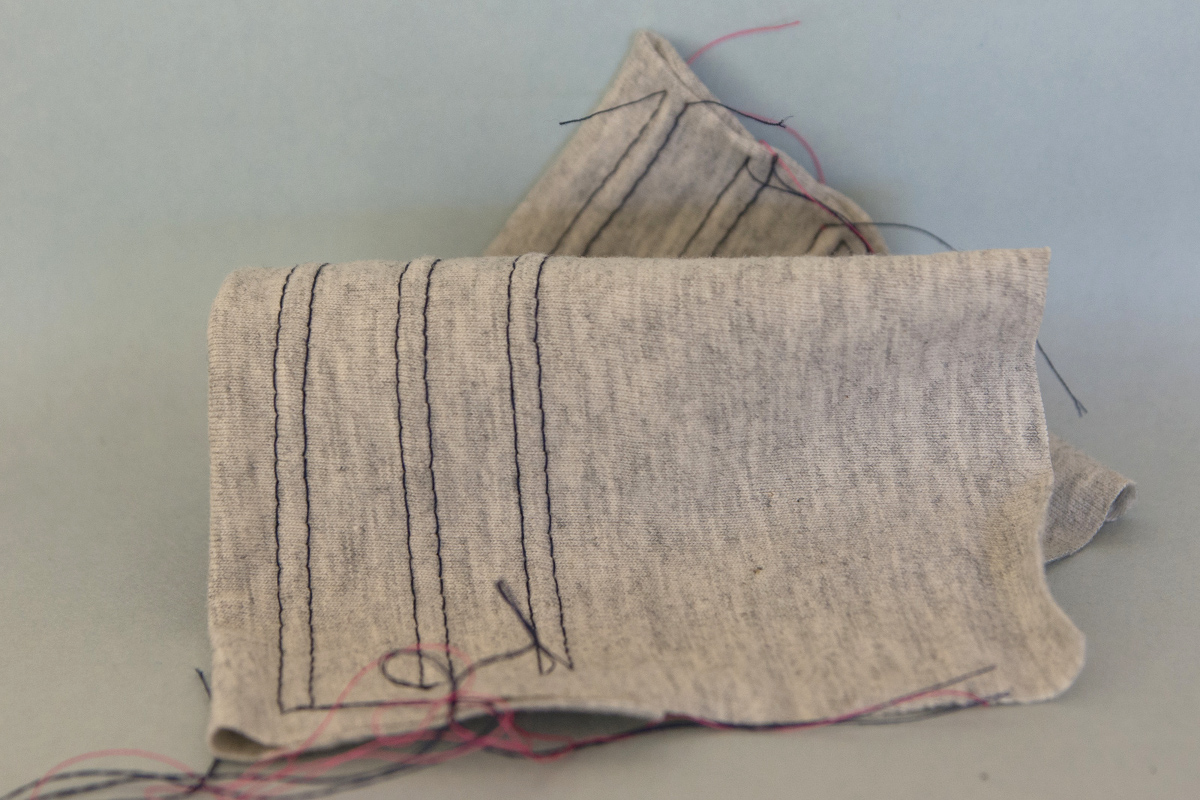
A twin needle is exactly what it sounds like. Two needles share one shank and clamp into your machine like a single needle. Thread two spools through your machine’s normal path, separate them at the end, and put one thread through each needle. The result is two parallel lines of straight stitching on the top of the fabric and a zigzag-style interlock underneath, which lets the seam stretch with knit fabric instead of popping.
It will not replace a coverstitch machine for heavy production, but for hemming t-shirts, finishing knit necklines, topstitching jeans, and adding decorative parallel rows, it is one of the best value notions in sewing. This guide covers what it is, how to thread it, the tension settings that make it behave, and which machines can use one.
TL;DR: A twin needle is two needles on one shank that sews two parallel top lines with a stretchy zigzag underneath, which makes it ideal for hemming knits with a coverstitch look. Thread two spools through the same path, then one thread per needle, and never use the automatic needle threader. Set twin-needle mode if your machine has it, or keep the stitch width narrow enough that the needles cannot strike the plate. Test on a scrap first and loosen top tension slightly if the fabric tunnels between the lines.
What a Twin Needle Actually Does
On the top of the fabric, a twin needle produces two straight, parallel rows. Underneath, the single bobbin thread zigzags back and forth between the two needle threads. That zigzag on the underside is the key: it gives the seam give, so a hem on a stretchy t-shirt can flex without the threads snapping.
Twin needles are sold by two numbers: the distance between the needles and the needle size. A 4.0/80 is the classic all-rounder, 4 mm apart, size 80. Narrower spacings like 2.0 and 2.5 mm suit lightweight fabrics and decorative work, while 6.0 mm is for bold topstitching. For knits, look for stretch or ballpoint twin needles, which have rounded tips that slip between knit loops instead of piercing them. Schmetz is the brand sewing teachers recommend most often for twin needles, and multipacks with several spacings are the economical way to experiment.
If you already know the fabric but not the size, the twin needle size selector gives the starting EU and US size by fabric weight.
Which Machines Support a Twin Needle
Most modern zigzag machines support twin needles, but not all. The requirements are simple:
A zigzag-capable machine. The needle plate must have a wide slot, not a single small round hole. Straight-stitch-only machines and machines with a straight-stitch plate installed cannot take a twin needle safely.
Front-to-back threading. The machine must thread with the needle eye facing front to back, which is standard on nearly all domestic machines. Machines that thread side to side need a different needle orientation and generally do not work with twin needles.
A second spool pin. You need two spools feeding at once. Many machines include a second spool pin or a hole for one in the accessories. If yours does not, winding a bobbin with your second thread color and placing it on the main spool pin works as a substitute.
Twin-needle mode (nice to have). Many computerized machines have a twin-needle setting where you enter the needle spacing. The machine then limits the stitch width automatically so the needles cannot swing wide and strike the needle plate. If your machine lacks this, you must limit the width manually.
Check your manual before you start. If it mentions twin-needle sewing, you are cleared for takeoff.
How to Thread a Twin Needle
Threading looks intimidating the first time and becomes routine by the third. Here is the method:
Install the needle with the flat side of the shank facing back, exactly like a normal needle. Tighten the clamp firmly.
Place two spools on the spool pins. If you only have one spool of your thread, wind a bobbin with the same thread and use it as the second spool. Run both threads together through every guide and tension disc, exactly as you would for single-needle sewing. Keep the two threads parallel and untwisted.
Separate at the needles. At the needle bar thread guide, pass one thread to the left side and one to the right. Thread the left needle with the left thread and the right needle with the right thread. Do not cross them.
Skip the automatic needle threader. The threader is designed for one thread and one needle. Forcing two threads through it can bend or break the mechanism, and that repair is not cheap. Thread both needles by hand.
Set your stitch. Select straight stitch. If your machine has twin-needle mode, turn it on and enter your spacing (4.0 for a 4.0 needle). If not, set the stitch width to 0 or keep it very narrow, and never select a zigzag or decorative stitch wider than the safe range for your needle spacing. A 4.0 mm twin needle with the machine set to a 5 mm zigzag will smash both needles into the plate.
Test on a scrap of your actual fabric, doubled as your hem will be. Check the top for two even lines and the underside for a neat zigzag with no loops or tunneling.
Tension Settings That Work
Twin-needle sewing is fussier about tension than single-needle sewing, because two top threads are fighting one bobbin thread. Start with your normal tension setting and adjust from the test swatch.
If the fabric tunnels (a raised ridge forms between the two lines, like a tiny tunnel), the top tension is too tight and the bobbin thread is pulling the fabric up between the needles. Loosen the top tension gradually, usually down to around 3 on a 0 to 9 dial, until the ridge flattens. Increasing the stitch length slightly also helps, as does placing a strip of wash-away stabilizer under the hem.
If loops show on the underside, the top tension is too loose or one thread missed the tension discs. Rethread with the presser foot up so the threads seat fully in the discs, then tighten slightly.
If one line looks fine and the other loops, one thread is not seated correctly. Rethread both from the start rather than trying to fix one.
If stitches skip on knits, switch to a stretch twin needle (ballpoint) and consider a slightly larger size. Skipped stitches on knits are almost always a needle-point problem, not a tension problem.
As a starting recipe for a medium-weight cotton jersey with a 4.0 stretch twin needle: straight stitch, length 3.0 mm, width 0, top tension a touch below normal. Adjust from there based on your test swatch.
Hemming Knits Like a Coverstitch
This is the application that makes twin needles famous. A t-shirt hem done with a twin needle shows two parallel lines on the outside and a flexible zigzag inside, which reads as a coverstitch to everyone but a sewing judge.
The method: press the hem up and pin or baste it. Sew from the right side of the garment so you can follow the folded edge as your guide. Keep the left needle line about 1/4 inch from the raw edge underneath (the raw edge should fall between the two needle lines or just inside the left one). Sew slowly and let the feed dogs do the work. Do not push or pull the knit, or the hem will wave.
For necklines and sleeve hems on stretchy fabric, stabilize first. A strip of fusible knit interfacing or clear elastic inside the hem keeps it from stretching out as you sew. Owners report that this one step is the difference between a professional-looking tee and a wavy mess.
Twin needles also shine for topstitching jeans (use a 4.0 or 6.0 jeans twin needle and topstitching thread in both needles), pintucks on blouses (narrow spacing, corded effect with a pintuck foot), and decorative parallel rows on quilts and bags.

A Multipack Worth Having
Twin needles are cheap individually, but buying one spacing at a time gets expensive and slow. A multipack with 2.0, 3.0, and 4.0 mm spacings covers decorative work, standard hems, and bold topstitching in one purchase. Schmetz makes the twin needles sewing teachers reach for, and they are worth mentioning by name since quality control on no-name needles is inconsistent. If you want to try several spacings at once, a twin needle multipack with 2.0, 3.0, and 4.0 mm sizes is the budget-friendly way to experiment before committing to Schmetz singles in your favorite size.
Common Mistakes to Avoid
Using the automatic needle threader. It is built for one thread. Thread twin needles by hand or risk a repair bill.
Selecting a wide zigzag with a wide twin needle. The needles swing into the plate and snap. Use twin-needle mode or keep width at zero.
Threading both threads through one needle eye. Each needle gets exactly one thread. Two threads in one eye causes jams and broken needles.
Skipping the test swatch. Twin-needle tension behaves differently on every fabric. Always test on a doubled scrap of the real fabric first.
Using a universal twin needle on knits. The sharp point can cut knit loops and cause runs. Use a stretch (ballpoint) twin needle for jersey and other knits.
Forgetting the second spool pin. Two threads from one spool will twist and tangle. Use a second spool, or a wound bobbin as the second thread source.
Pulling the fabric. Let the feed dogs move the work. Pulling stretches knits and guarantees a wavy hem.
FAQs
Can any sewing machine use a twin needle?
Most zigzag machines with front-to-back threading can, as long as the needle plate has a wide slot. Straight-stitch-only machines cannot. Check your manual for a twin-needle section to be sure.
Why is my fabric tunneling between the two lines?
Tunneling means the top tension is pulling the fabric up between the needles. Loosen the top tension, lengthen the stitch slightly, and try a strip of stabilizer under the fabric. It is the most common twin-needle complaint and it is fixable.
Do I need special thread for a twin needle?
No. Regular all-purpose polyester thread works for both needles. Use topstitching thread in both needles for decorative jeans topstitching, and woolly nylon in the bobbin only if your machine handles it well (test first).
What is the difference between a twin needle and a double needle?
Nothing. The terms are interchangeable. Both mean two needles on one shank.
Can I sew a zigzag stitch with a twin needle?
Only with narrow spacing and only if the total swing stays within the needle plate slot. This is where twin-needle mode earns its keep. When in doubt, stick to straight stitch, which is what hems and topstitching need anyway.
How long do twin needles last?
Treat them like single needles: replace after 6 to 8 hours of sewing, or sooner if you hear a popping sound, see skipped stitches, or hit a pin. Dull twin needles cause twice the trouble of dull singles.