
As an Amazon Associate I earn from qualifying purchases.
The Brother 1034D is the world’s best-selling serger for a reason: it is cheap, it works, and it teaches you what serging is. But every 1034D owner eventually hits the same wall. The knives dull faster than you’d like. The tension dials feel vague. Differential feed helps, but the machine still complains on genuinely heavy fabric. And when a project calls for a chainstitch or a coverstitch, the 1034D just shrugs.
Upgrading a serger is not about more stitches. It is about better engineering: sharper, longer-lasting knives with a dedicated drive; industrial-style tension dials that stay where you put them; differential feed with real range; and on the best machines, 5-thread capability that adds chainstitch and coverstitch to your repertoire. These five machines are the ones 1034D graduates actually buy, ranked by what the extra money buys you.
TL;DR: The Juki MO-654DE (~$410-550) is the classic 1034D upgrade: same 2/3/4-thread versatility with industrial-grade tension and a knife system in another league. The Juki MO-735 (~$1,000-1,300) adds 5-thread chainstitch and coverstitch for sewists who want one machine to do it all. The Brother 1034DX (~$200-280) is the mild refresh if your 1034D is simply worn out.
At a Glance, Our Scores
| Pick | Best for | Our score | Typical price | Buy |
|---|---|---|---|---|
| Juki MO-654DE | Best 1034D upgrade | 9.4/10, industrial tension and knives that embarrass the 1034D | ~$410-550 | Check Price on Amazon |
| Juki MO-735 | Best 5-thread combo | 9.2/10, overlock plus chainstitch and coverstitch in one machine | ~$1,000-1,300 | Check Price on Amazon |
| Brother 1034DX | Best mild refresh | 8.3/10, the 1034D formula with a trim trap and metal frame touches | ~$200-280 | Check Price on Amazon |
| Singer ProFinish 14CG754 | Best budget heavy-duty feel | 8.1/10, metal frame and 2/3/4-thread versatility for less | ~$200-260 | Check Price on Amazon |
| Baby Lock Vibrant | Best dealer-channel pick | 8.6/10, lay-in tensions and beginner-friendly engineering | ~$400-525 | Authorized dealers only |
Prices move constantly on Amazon, every “Check Price on Amazon” link below takes you to the live listing.
Quick Picks
- Best upgrade: Juki MO-654DE (~$410-550).
- Best do-everything: Juki MO-735 (~$1,000-1,300).
- Cheapest refresh: Brother 1034DX (~$200-280).
1. Juki MO-654DE

Ask serger enthusiasts what to buy after the 1034D and the MO-654DE wins the poll so often it is barely a contest. On paper it looks similar: 2/3/4-thread overlock, differential feed, 1,500 spm. In use, everything feels like it was designed by people who build industrial machines, because it was. The tension dials are industrial-type with a full rotation and they hold their settings. The knife system has a dedicated drive mechanism and cuts cleanly through heavy fabric where the 1034D’s knives start to chew. Stitch length and differential feed adjust from outside the machine, no cover-flipping.
Owners report that the 654DE simply stays in adjustment. Thread it once, dial in your fabric, and it serges the same stitch on the first seam and the fiftieth. The automatic rolled hem conversion is quick, the color-coded threading is clear, and the machine handles light to heavyweight fabric without the tension tantrums that drive 1034D owners to forums.
The honest trade-off: threading is still threading. The 654DE does not have air threading, so if your nemesis is the loopers rather than stitch quality, look at air-thread models instead. But for stitch quality per dollar, this is the upgrade that makes 1034D owners wonder why they waited.
Good
✓ Industrial-type tension dials that stay put
✓ Powerful knife system with dedicated drive, cuts heavy fabric cleanly
✓ External dials for stitch length and differential feed
✓ 1,500 spm with consistent stitch quality across fabrics
Watch out for
✕ No air threading, manual looper threading like the 1034D
✕ Heavier and less portable than the Brother
✕ Rolled hem setup still takes a minute to learn
2. Juki MO-735

The MO-735 answers a different question: what if you don’t want a serger and a coverstitch machine, you want one machine that does both? This is a 2/3/4/5-thread machine that adds chainstitch, 5-thread safety stitch, and 2- or 3-needle coverstitch to the standard overlock repertoire. For garment sewists, that means professional seam finishing and professional hems from a single machine.
Conversion between overlock and coverstitch modes is the make-or-break feature on combo machines, and owners report the 735’s system is workable rather than wonderful: it takes a few minutes and some practice, but it is reliable once learned. The same Juki DNA as the 654DE shows in the heavy-duty knife system, the 1,500 spm speed, and the differential feed range of 0.7 to 2.0. It handles everything from lightweight knits to heavyweight wovens, and the multi-purpose presser foot works across modes.
The price is the conversation. At roughly double the 654DE, you are paying for the coverstitch capability. If you already own a coverstitch machine or never sew knits, the 654DE is the smarter buy. If you sew a lot of garments and want one machine that finishes seams and hems them too, the 735 earns its keep.
Good
✓ 5-thread safety stitch plus chainstitch and coverstitch modes
✓ Same heavy-duty knife system and 1,500 spm as the 654DE
✓ One machine for seams and hems, ideal for garment sewists
✓ Handles ultra-light to heavyweight fabrics
Watch out for
✕ Mode conversion takes practice
✕ Roughly double the price of the 654DE
✕ Overkill if you already own a coverstitch machine
3. Brother 1034DX
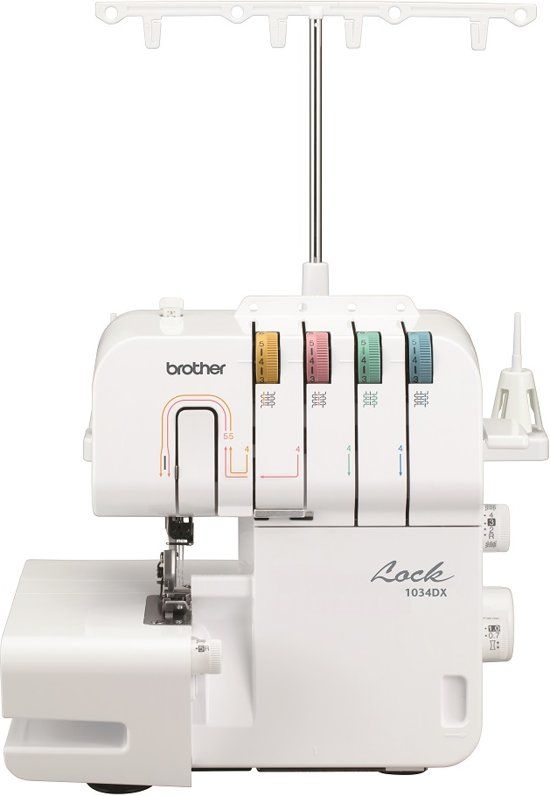
Sometimes the upgrade you need is just a new machine. If your 1034D is a decade old, the knives are tired, and the tension dials have seen better days, the 1034DX is the current-generation refresh of the same formula: 3/4-thread overlock, differential feed, 1,300 spm, color-coded threading, and a metal frame. Brother added a trim trap that catches fabric trimmings as you serge (and doubles as foot-controller storage), plus an instructional DVD and three accessory feet in the box.
Let’s be clear about what this is and isn’t. It is not a performance upgrade over a healthy 1034D; the stitch quality and capability are essentially the same. It is a replacement, and a sensible one if your old machine owes you nothing. Owners report the same easy threading, the same forgiving learning curve, and the same 25-year limited warranty with lifetime technical support.
Buy the 1034DX if your 1034D is worn out and you liked it. Buy the Juki if you want to feel a real difference. There is no wrong answer here, only an honest assessment of whether your machine is tired or you are.
Good
✓ Same beloved 1034D formula, current production
✓ Trim trap keeps the workspace clean
✓ Easy color-coded threading, great for beginners
✓ 25-year warranty with lifetime support
Watch out for
✕ Not a performance upgrade over a working 1034D
✕ 3/4 thread only, no chainstitch or coverstitch
✕ Knives and tension are a step below the Jukis
4. Singer ProFinish 14CG754

The ProFinish 14CG754 is Singer’s answer to the budget serger question, and it deserves a spot for buyers who want a heavier-feeling machine without Juki money. The headline specs are competitive: 2/3/4-thread capability, 1,300 spm, differential feed, adjustable stitch length and width, and four built-in rolled hems. Singer puts it in a heavy-duty metal frame, and owners report it feels more planted than its price suggests.
Threading uses a color-coded lay-in system that beginners find approachable, and the free arm (accessed by removing the cloth plate) is genuinely useful for cuffs and children’s clothing. The 25-year limited warranty matches the category standard.
The caveats are the ones budget sergers always carry. Owners report more plastic in the housing than the marketing implies, noise levels above the Jukis, and a knife system that is adequate rather than excellent. Tension can need more babysitting across fabric changes than on the MO-654DE. This is the pick for the sewist who serges occasionally and wants the most machine for the least money, not for the heavy user who will notice the difference every session.
Good
✓ Heavy-duty metal frame at a budget price
✓ 2/3/4-thread with four built-in rolled hems
✓ Free arm for cuffs and small openings
✓ Color-coded threading beginners can follow
Watch out for
✕ More plastic housing than expected, noisier than Jukis
✕ Knife system is adequate, not excellent
✕ Tension needs more attention across fabrics
5. Baby Lock Vibrant

Baby Lock does not sell through Amazon, which is why there is no buy button here: the Vibrant is available through Baby Lock’s site and authorized dealers, typically around $400 to $525. It earns its place as the dealer-channel alternative for buyers who value hand-holding.
The Vibrant is a 4/3/2-thread serger aimed squarely at first-time and nervous serger owners. The standout feature is lay-in tensions, which make the threading path more forgiving than traditional tension discs. It includes a trim bin, uses color-coded threading, and Baby Lock’s dealer network means you can often get an in-person lesson with purchase, something no Amazon listing offers. The company’s serger lineup is widely regarded as the easiest to learn on.
The trade-off is capability per dollar. At Vibrant money you can buy the Juki MO-654DE, which outclasses it on knives, tension precision, and speed. What the Vibrant offers instead is the gentlest learning curve in the category and dealer support. For a buyer upgrading from a 1034D who found serging stressful rather than fun, that support has real value.
Good
✓ Lay-in tensions and color coding, the friendliest threading here
✓ Dealer network often includes lessons with purchase
✓ Trim bin included
✓ Baby Lock’s beginner-friendly reputation is well earned
Watch out for
✕ No Amazon availability, dealer purchase required
✕ Less machine per dollar than the Juki MO-654DE
✕ 4/3/2 thread, no 5-thread option
The Vibrant is sold through Baby Lock and authorized dealers, not Amazon.
How We Picked
We started from the 1034D owner’s perspective: what actually frustrates you, and what fixes it. Knife quality and longevity ranked first, because dull knives are the number one reason sergers start producing chewed edges. Tension system quality came second: industrial-style dials that hold settings beat vague dials that drift. Differential feed range and external adjustability mattered because wavy knits and puckered wovens are the visible difference between a cheap serger and a good one. We gave credit for 5-thread capability and coverstitch modes since “outgrowing” often means wanting new stitch types, not just better old ones. Finally, we weighted owner reports on reliability over years of use, not first impressions, and excluded machines with recurring complaints about timing issues or parts availability.
FAQs
Is the Juki MO-654DE really that much better than the Brother 1034D?
For stitch consistency and longevity, yes. The differences are in the tension system, the knives, and the general solidity: the Juki holds adjustment where the Brother drifts, and its knives stay sharp far longer. It is not more versatile on paper, it is better engineered in practice.
Do I need a 5-thread serger?
Only if you want chainstitch or coverstitch capability. A 5-thread safety stitch is stronger for garment seams, and the coverstitch mode hems knits professionally. If you only finish seam allowances on wovens, 3/4 thread is plenty.
What does differential feed actually do?
It lets the front feed dogs move at a different rate than the rear ones. Set above 1.0 to ease in stretchy knits without waviness; below 1.0 to prevent puckering on lightweight wovens. It is the single most useful serger feature after the knives.
How often do serger knives need replacing?
It depends on use and fabric, but owner consensus is roughly every one to two years of regular use for the 1034D class, longer for the Juki’s heavier knife system. Dull knives announce themselves with chewed or frayed cut edges.
Can a serger replace a sewing machine?
No. Sergers finish edges and sew knit seams brilliantly, but they cannot do buttonholes, zippers, topstitching, or straight-stitch construction the way a sewing machine can. They are companions, not replacements.
Is air threading worth paying extra for?
If threading loopers is what you dread, absolutely. Air threading blows the looper threads through in seconds. If your frustration is stitch quality rather than threading, spend the money on better engineering (the Jukis) instead.