
As an Amazon Associate I earn from qualifying purchases.
The fear is universal: you mark your fabric carefully, sew beautifully, and then the marks will not come out. Every sewist has either lived this or watched someone else live it. The fix is not to stop marking, it is to mark with the right tool for the job and to test it on your fabric first. Always test on a scrap. Always.
Fabric markers fall into four families, and understanding them matters more than any single product pick. Air-erase inks vanish on their own within days. Water-erase inks wash out with a damp cloth or laundering. Heat-erase inks disappear with an iron’s touch. Chalk and tracing papers brush or wash away mechanically. Each has a job it does best and a way it can betray you.
We compared the markers quilters and garment sewists actually use, weighing line precision, visibility on light and dark fabrics, removal reliability, and owner-reported mishaps. Prices are ballparks.
TL;DR: The Dritz 3086 Disappearing Ink Pen (~$4-7) is the best all-around fabric marker: fine purple lines that vanish on their own in a few days. For marks you want to control, the Dritz 700 Fine Line water-erasable pen (~$4-7) removes with plain water. Heat-erase fans should get the Lange and Konig set (~$8-12), and traditionalists will love the Fons and Porter chalk pencils (~$7-10).
At a Glance, Our Scores
| Pick | Best for | Our score | Typical price | Buy |
|---|---|---|---|---|
| Dritz 3086 Disappearing Ink Pen | Best overall (air-erase) | 9.3/10, fine purple lines that vanish on their own | ~$4-7 | Check Price on Amazon |
| Dritz 700 Fine Line Water Erasable | Best water-erase | 9.0/10, pinpoint blue lines removed with plain water | ~$4-7 | Check Price on Amazon |
| Lange & Konig Heat Erasable Pens | Best heat-erase | 8.9/10, four colors plus refills, vanish with iron heat | ~$8-12 | Check Price on Amazon |
| Fons & Porter Chalk Pencils 4-Pack | Best chalk | 8.8/10, four colors, brush or wash away cleanly | ~$7-10 | Check Price on Amazon |
| Fons & Porter 7757 Mechanical Pencil | Best mechanical | 8.7/10, 0.9mm ceramic lead, perfect for dark fabrics | ~$9-13 | Check Price on Amazon |
| Clover Chacopy Tracing Paper | Best tracing paper | 8.6/10, five colors, transfers patterns without pens | ~$6-9 | Check Price on Amazon |
Prices move constantly on Amazon, every “Check Price on Amazon” link below takes you to the live listing.
Quick Picks
- Best overall: Dritz 3086 disappearing ink (~$4-7). Mark it, sew it, watch it vanish.
- Best water-erase: Dritz 700 Fine Line (~$4-7). Precise blue lines, gone with water.
- Best heat-erase: Lange and Konig set (~$8-12). Iron them away in seconds.
- Best chalk: Fons and Porter 4-pack (~$7-10). The traditional choice, four colors.
- Best for dark fabric: Fons and Porter 7757 mechanical (~$9-13). White ceramic lead.
1. Dritz 3086 Disappearing Ink Marking Pen
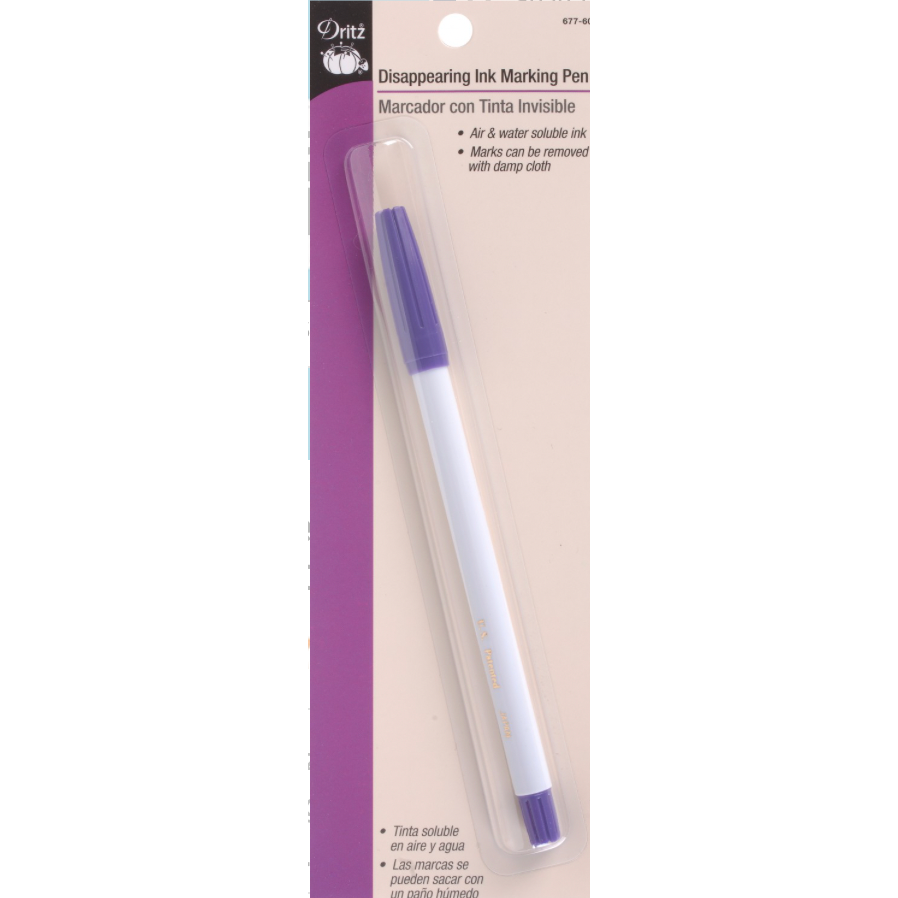
The Dritz 3086 is the marker most sewists reach for first, and the reason is convenience: draw your lines in bright purple, do your sewing, and the marks fade away on their own within two to three days. No washing, no ironing, no second step. For quilting, embroidery placement, and pattern markings on projects you will finish within a few days, it is the lowest-friction option that exists.
The fine point draws thin, precise lines that owners say are easy to follow without obscuring the fabric. The purple shows up clearly on light and medium fabrics, which covers most quilting cottons. Dritz notes it is for washable fabrics, and marks can also be removed sooner with water if you do not want to wait.
The catch is the timeline. Air-erase ink waits for no one: if your project sits for a week, the marks may be gone before you sew. Do not use it on anything you will not finish promptly, and never iron over the marks before they are gone, since heat can set some disappearing inks. Used as intended, though, it is nearly foolproof.
Good
✓ Marks vanish on their own in 2 to 3 days, no removal step
✓ Fine point for precise quilting and embroidery lines
✓ Bright purple visible on light and medium fabrics
✓ Can also be removed early with water
Watch out for
✕ Do not use on projects you will not finish within days
✕ Never iron over marks before removal; heat can set them
2. Dritz 700 Fine Line Water Erasable Marking Pen
When you want your marks to stay put until you decide they are done, water-erase is the answer. The Dritz 700 draws an exceptionally fine 0.5mm blue line, the thinnest on this list, which makes it ideal for precise work: stitch-in-the-ditch guides, applique placement, and detailed embroidery transfers. Owners praise the line quality, sharp and consistent without the skipping that plagues cheap markers.
Removal is simple: plain water. Dab with a damp cloth or launder the finished piece and the blue vanishes. Unlike air-erase inks, it will not disappear while your project waits its turn in the UFO pile, which makes it the better choice for slow or complex projects.
The standard warnings apply. Test on a scrap first, use it on washable fabrics, and remove the marks before ironing or laundering with heat. A few owners note that on some fabrics the blue needs a proper rinse rather than a quick dab, so do not assume a dry project is a clean project.
Good
✓ 0.5mm pinpoint line, the finest on this list
✓ Stays visible until you remove it, ideal for slow projects
✓ Removes with plain water, no special products
✓ Excellent for applique and embroidery placement
Watch out for
✕ Blue can need a real rinse on some fabrics, not just a dab
✕ For washable fabrics; remove before heat pressing
3. Lange & Konig Heat Erasable Fabric Marking Pens

Heat-erase pens are the newest family and the most satisfying to use: touch the mark with an iron and it vanishes in seconds. The Lange and Konig set includes four pens in black, white, red, and blue, plus eight refills, so you have a visible color for any fabric. The white pen is the standout: it marks dark fabrics clearly, solving the oldest problem in fabric marking.
Owners report that the 0.5mm lines are smooth and precise, and the ink disappears completely with heat, leaving no ghost marks on most fabrics. With refills included, the set lasts through many projects, and replacement refills are inexpensive. It is currently one of the best-selling marking tools on Amazon, which says something about how well the concept works in practice.
Know the quirks before you commit. Heat-erase ink can reappear in cold temperatures on some fabrics, so finished garments that go through winter may show ghost lines in the cold. And as with all markers, test on a scrap first, especially on heat-sensitive fabrics.
Good
✓ Four colors including white for dark fabrics
✓ Marks vanish in seconds with iron heat
✓ Eight refills included, long-lasting set
✓ Smooth 0.5mm lines with no ghosting on most fabrics
Watch out for
✕ Marks can reappear in cold temperatures on some fabrics
✕ Test on heat-sensitive fabrics before committing
4. Fons & Porter Chalk Pencils, 4-Pack
Sometimes the old ways are the best ways. Tailor’s chalk has marked fabric for centuries, and Fons and Porter’s chalk pencils are the modern refined version: four pencils in white, blue, gray, and yellow, with fine points that draw crisp lines. Chalk marks brush off with your hand or a soft brush, and any residue washes out.
Owners love these for quilting because chalk is forgiving. Mark a line, change your mind, brush it away, mark again. The four colors cover light fabrics (blue, gray), dark fabrics (white, yellow), and everything between. The pencil format gives more control than traditional chalk wedges, and the lines are fine enough for accurate piecing.
Chalk’s weakness is durability: the marks rub off with handling, so they are best for marks you will sew soon. They can also be less visible on textured fabrics. But for the price, this 4-pack belongs in every sewing kit as the reliable backup that never dries out, never fades early, and never surprises you.
Good
✓ Four colors for light and dark fabrics
✓ Marks brush or wash away easily
✓ Pencil format gives precise control
✓ Never dries out or expires
Watch out for
✕ Marks rub off with handling, best for short-term marking
✕ Less visible on heavily textured fabrics
5. Fons & Porter 7757 Mechanical Fabric Pencil
Dark fabric is the nemesis of most markers, and the Fons and Porter 7757 is the purpose-built solution. It is a mechanical pencil loaded with 0.9mm white ceramic lead, specially formulated for fabric from water-soluble dyes. The lead draws fine, bright white lines on dark fabrics that are easy to see and easy to follow.
The mechanical format is the advantage: no sharpening, consistent line width, and a soft grip for comfort. The set includes ten leads in a storage tube, and the marks remove with the included eraser, a damp cloth, or laundering. Owners report that the ceramic lead is strong enough not to snap constantly, which is the usual complaint about mechanical fabric pencils.
It is a specialist tool: on light fabrics you will reach for something else. But if you sew with dark quilting cottons, denim, or black garments, this pencil earns its place. Keep the spare leads somewhere you will find them; they are small.
Good
✓ Bright white lines on dark fabrics
✓ 0.9mm ceramic lead, strong and consistent
✓ Mechanical format, no sharpening ever
✓ Ten leads included; marks erase, rinse, or wash out
Watch out for
✕ White only, not useful on light fabrics
✕ Tiny spare leads are easy to misplace
6. Clover Chacopy Tracing Paper
Not every marking job needs a pen. Clover’s Chacopy tracing paper transfers pattern lines, embroidery designs, and quilting motifs directly onto fabric: lay the paper between your pattern and fabric, trace with a stylus or empty ballpoint, and the chalk-based coating leaves a clean line. The 5-pack includes blue, green, red, white, and yellow sheets for any fabric color.
Owners report that the lines are stronger and more visible than generic tracing papers, and the marks wash out reliably. It is the best method for transferring complex designs like embroidery patterns, where drawing freehand would be impractical. The single-sided coating means no accidental marks on the wrong side.
It is a different workflow from pens, and for quick straight lines a pen is faster. But for pattern transfer it has no equal at this price. Pair it with a tracing wheel or stylus if you do not already own one.
Good
✓ Five colors for any fabric
✓ Stronger, more visible lines than generic tracing paper
✓ Best method for transferring complex designs
✓ Marks wash out reliably
Watch out for
✕ Slower than a pen for simple straight lines
✕ Needs a stylus or tracing wheel to use
How We Picked
We organized the field by removal method first, because the right marker depends on how you want the marks to disappear. Within each family we compared line precision, visibility, removal reliability, and owner-reported problems like ghosting or reappearing marks.
We read owner reviews on Amazon and sewing forums, paying special attention to mishap reports: marks that would not wash out, heat-set disappearing ink, and cold-reappearing heat-erase lines. Products with consistent removal complaints were excluded regardless of popularity. We did not lab-test removal ourselves; scores reflect aggregated owner experience and how well each product serves its marking job.
FAQs
What is the difference between air-erase, water-erase, and heat-erase markers?
Air-erase inks fade on their own within days. Water-erase inks stay until removed with water. Heat-erase inks vanish with an iron’s heat. Choose air-erase for quick projects, water-erase for slow ones, and heat-erase when you want instant removal during pressing.
Why should I test a fabric marker on a scrap first?
Because fabric, dye, and finish combinations are unpredictable. A marker that washes out of quilting cotton might stain silk or a coated fabric. A 30-second test on a scrap from your actual project fabric prevents disasters.
Can I iron over disappearing ink marks?
No. Heat can set many disappearing and water-soluble inks, making them permanent. Always remove marks completely before pressing. This is the most common cause of “my marker did not wash out” complaints.
Why did my heat-erase marks come back in the cold?
Some heat-erase inks are thermochromic: they become invisible with heat but can reappear at low temperatures. It is a known quirk of the chemistry. Washing the finished item usually removes the ink permanently.
What is the best marker for dark fabric?
White options: the Lange and Konig set’s white heat-erase pen, Fons and Porter chalk pencils in white or yellow, or the 7757 mechanical pencil with white ceramic lead. Test first, since white marks can be the hardest to fully remove from some dark fabrics.
How do I remove tailor’s chalk from fabric?
Brush it off with your hand or a soft brush for fresh marks. For stubborn residue, launder as usual. Chalk is the most forgiving marking method, which is why it has survived centuries.