
As an Amazon Associate I earn from qualifying purchases.
If you quilt or sew regularly, a rotary cutter will change your cutting life more than almost any other tool. Scissors lift the fabric as you cut, which distorts it. A rotary cutter rolls through fabric pressed flat on a mat, so your strips stay straight and your squares come out square. The difference in accuracy is not subtle.
Not every rotary cutter is equal, though. The blade size, handle shape, and safety mechanism all matter, and a bad fit can leave your hand aching after one cutting session. Based on thousands of buyer reviews and sewing forum discussions, these five cutters are the ones quilters keep recommending year after year.
TL;DR: The Olfa 45mm Quick-Change RTY-2/DX (~$30-40) is the quilter’s standard and our top pick. The Fiskars 45mm Original (~$10-15) cuts just as well for less money. If cutting hurts your hand or wrist, the Martelli Ergo 2000 (~$30-40) is worth every penny.
At a Glance, Our Scores
| Pick | Best for | Our score | Typical price | Buy |
|---|---|---|---|---|
| Olfa 45mm Quick-Change Rotary Cutter (RTY-2/DX) | Best overall | 9.4/10, the quilter’s standard cutter | ~$30-40 | Check Price on Amazon |
| Fiskars 45mm Original Rotary Cutter | Best budget | 8.8/10, cuts great for little money | ~$10-15 | Check Price on Amazon |
| Martelli Ergo 2000 Rotary Cutter (45mm) | Best ergonomic | 9.0/10, pain-free cutting design | ~$30-40 | Check Price on Amazon |
| Olfa 28mm Quick-Change Rotary Cutter (RTY-1/C) | Best for curves | 8.7/10, precise small-scale cutting | ~$20-25 | Check Price on Amazon |
| Fiskars 45mm Titanium Loop Rotary Cutter | Longest-lasting blade | 8.6/10, titanium coating lasts longer | ~$25-35 | Check Price on Amazon |
Prices move constantly on Amazon, every “Check Price on Amazon” link below takes you to the live listing.
Quick Picks
- Best overall: Olfa 45mm Quick-Change RTY-2/DX, the industry standard quilters trust, ~$30-40.
- Best budget: Fiskars 45mm Original, the cheapest cutter that still cuts clean, ~$10-15.
- Best ergonomic: Martelli Ergo 2000, the dough-roller grip that saves sore wrists, ~$30-40.
- Best for curves: Olfa 28mm RTY-1/C, for tight corners and small pieces, ~$20-25.
- Longest-lasting blade: Fiskars 45mm Titanium Loop, titanium-coated blade stays sharp longer, ~$25-35.
Detailed Reviews
1. Olfa 45mm Quick-Change Rotary Cutter (RTY-2/DX), Best Overall
Olfa invented the rotary cutter in 1979, and the RTY-2/DX is the model that shows up in more sewing rooms than any other. The curved ergonomic handle fits the hand naturally, and the squeeze trigger exposes the blade while you cut and retracts it when you let go. That self-retracting action is a genuine safety upgrade over cutters you have to lock and unlock manually.
It comes pre-loaded with Olfa’s RB45-1H Endurance blade, which owners report stays sharp noticeably longer than standard blades. The quick-change blade system makes swapping a dull blade a two-step job with no tools. Quilting forums consistently recommend this exact cutter as the first one to buy, and it is the one you will see in most YouTube quilting tutorials.

Good
✓ Self-retracting squeeze trigger keeps the blade covered when not cutting
✓ Pre-loaded with the long-life Endurance blade
✓ Tool-free quick-change blade swaps
✓ Contoured handle with anti-slip grip reduces hand fatigue
✓ Works for right- and left-handed users (blade assembly reverses)
✓ Accepts all standard 45mm replacement and decorative blades
Watch out for
✕ The squeeze mechanism needs a firm hand grip, which some buyers with very weak hands find tiring
✕ More expensive than basic straight-handle cutters
✕ The retractable trigger can feel awkward until you adjust your grip
✕ You will still need a self-healing mat, a ruler, and replacement blades
2. Fiskars 45mm Original Rotary Cutter, Best Budget
This is the classic orange stick-handle cutter that many sewists started with, and honestly, many never felt the need to upgrade. The symmetrical handle works equally well in either hand, the sliding button extends and locks the blade, and the whole thing costs about what you would pay for a couple of fast-food meals.
Buyer reviews consistently say it cuts cleanly through multiple layers of quilting cotton. Fiskars backs it with a lifetime warranty on the tool itself (not the blade), which is generous at this price. If you are not sure rotary cutting is for you, start here. You are risking very little money.

Good
✓ Extremely affordable, often the cheapest name-brand cutter
✓ Cuts cleanly through multiple fabric layers
✓ Ambidextrous symmetrical stick handle
✓ Blade locks open and retracts for storage
✓ Full lifetime warranty on the handle
Watch out for
✕ Thin stick handle is less comfortable on long cutting sessions
✕ The included standard blade dulls faster than premium Endurance blades
✕ Slide lock is a step slower than a squeeze trigger
✕ Handle is a bit short for very large hands
3. Martelli Ergo 2000 Rotary Cutter (45mm), Best Ergonomic
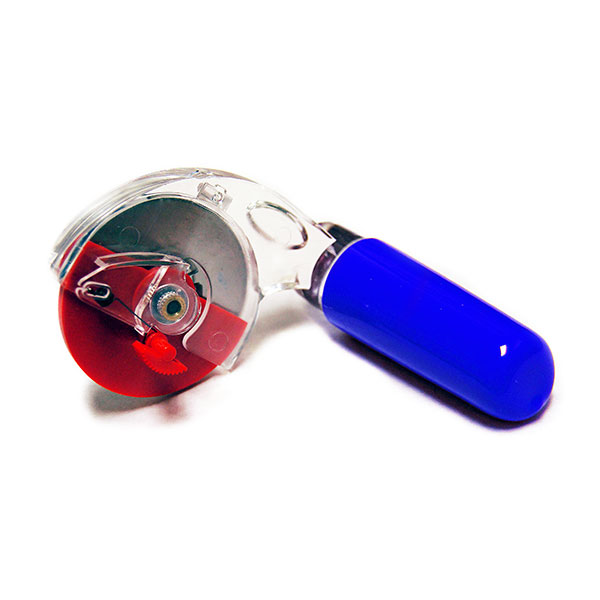
The Martelli looks strange at first glance. It has a chunky dough-roller style grip that you push forward rather than holding like a knife. But for anyone with arthritis, carpal tunnel, tendonitis, or wrist pain, this odd shape is the entire point. It spreads cutting pressure across your whole hand and arm instead of concentrating it in the wrist.
Owners with hand problems report being able to cut for long sessions that were impossible with a standard cutter. The spring-loaded blade guard covers the blade when you are not cutting. One important note: Martelli makes separate right- and left-handed versions, so check the listing carefully before ordering.
Good
✓ Ergonomic push grip dramatically reduces wrist strain
✓ Popular with quilters who have arthritis or carpal tunnel
✓ Spring-loaded blade guard for safety
✓ Tungsten steel blade holds an edge well
✓ Available in 28mm, 45mm, and 60mm sizes
Watch out for
✕ Unusual grip takes practice and feels weird at first
✕ Must order the correct hand version (this listing is right-handed)
✕ Bulkier than a standard cutter, harder to stash in a small notions bag
✕ Replacement blades cost more than standard 45mm blades
4. Olfa 28mm Quick-Change Rotary Cutter (RTY-1/C), Best for Curves
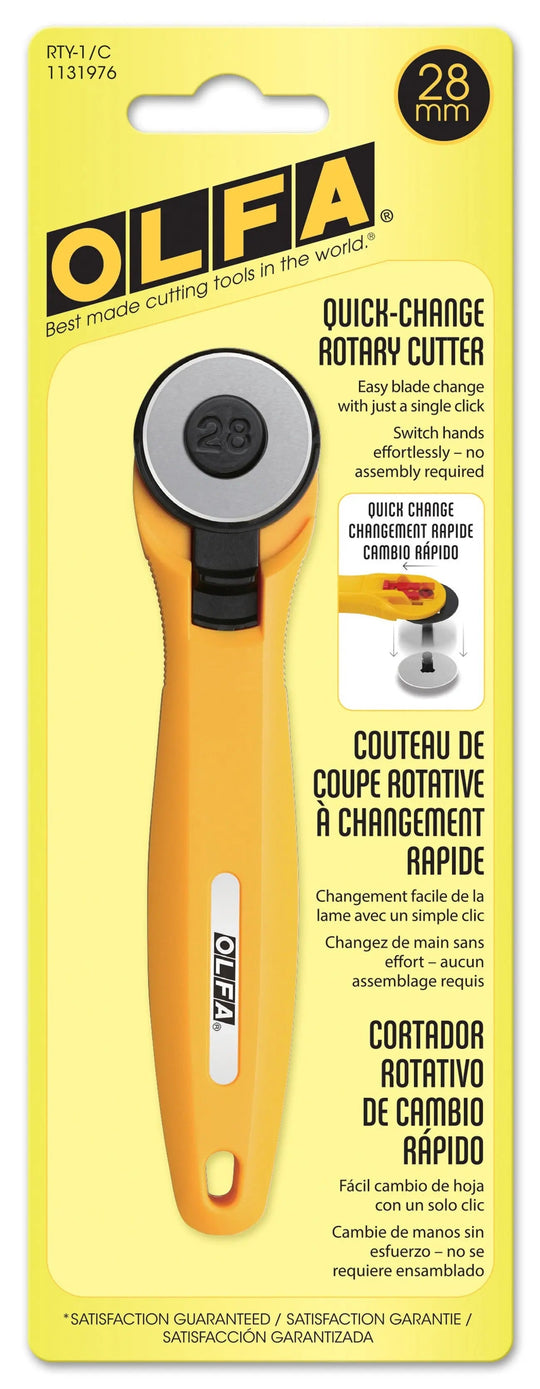
The 28mm blade is the specialist’s tool. Because the blade is smaller, it turns tight corners and curves that a 45mm blade would fight. Quilters reach for it for small pieces, applique work, paper piecing, and trimming around templates. Note that the correct model number for Olfa’s 28mm quick-change cutter is RTY-1/C (RTY-3 is the 60mm model).
It has the same tool-free quick-change blade system as its 45mm sibling, and the ABS handle suits both right- and left-handed users. Think of it as the second cutter to buy once your 45mm is doing the heavy lifting, not the first one.
Good
✓ Small blade navigates tight curves and corners easily
✓ Ideal for applique, miniatures, and paper piecing
✓ Same quick-change blade system as the 45mm models
✓ Ambidextrous handle
Watch out for
✕ Not meant for long straight cuts through many layers
✕ Blade wears faster on large projects since it is smaller
✕ An unnecessary purchase if you only cut straight strips
5. Fiskars 45mm Titanium Loop Rotary Cutter, Longest-Lasting Blade
The selling point here is the titanium-coated blade, which Fiskars says is significantly harder than plain steel. Buyers report going noticeably longer between blade changes compared to standard steel blades, which matters if you cut a lot of fabric. Fewer blade swaps also means fewer chances to nick yourself.
The loop handle has Softgrip touchpoints and a sliding button that extends, locks, and retracts the blade. It has fewer parts than some competing designs, which owners say makes blade changes faster. If your main complaint with your current cutter is how fast blades dull, this one earns its place.

Good
✓ Titanium coating keeps the blade sharp longer
✓ Comfortable loop handle with Softgrip
✓ Simple design means fewer parts and faster blade changes
✓ Full lifetime warranty on the tool
Watch out for
✕ Costs more than the basic Fiskars 45mm
✕ Loop handle is not for everyone (some prefer the stick style)
✕ Replacement titanium blades cost more than standard blades
✕ Heavier than the basic stick cutter
45mm vs 28mm vs 60mm: Which Blade Size Do You Need?
45mm is the default size and the one almost everyone should buy first. It cuts through up to 8 layers of quilting cotton cleanly, handles long strips and squares easily, and replacement blades are available everywhere. If you own one rotary cutter, it should be a 45mm.
28mm is for detail work. The smaller blade turns tighter curves, which makes it the right tool for applique, small quilt blocks, miniature projects, and paper piecing. It cannot power through many layers the way a 45mm can, so it is a second cutter, not a first one.
60mm is for thick and heavy materials. It cuts up to 12 layers of cotton and powers through fleece, felt, wool, leather, and denim. Most home quilters never need one, but if you regularly cut thick materials or stack many layers, the 60mm saves real effort. All three cutters above that offer multiple sizes let you step up to 60mm later.
One more thing: you cannot rotary cut without a self-healing mat and a quilting ruler. The blade will destroy a table and go dull fast on a hard surface. Budget for all three together.
What to Look For When Buying
- Blade size: Start with 45mm. It handles the vast majority of quilting and sewing cutting tasks.
- Safety mechanism: Squeeze-trigger self-retracting cutters are safest. Slide-lock and thumb-guard styles work fine but need more attention.
- Handle comfort: If you cut for more than 15 minutes at a time, an ergonomic handle is worth paying for. Hand pain is the number one reason quilters switch cutters.
- Blade change system: Quick-change systems save time and reduce the risk of handling a loose blade. Look for tool-free blade swaps.
- Replacement blade cost: Check what a pack of replacement blades costs before you buy. Cheap cutters with expensive blades are a false economy.
- Left-handed use: Most stick and quick-change cutters work for both hands. The Martelli requires buying the correct hand version.
- Always use a mat: A self-healing rotary mat is not optional. It protects your table and your blade.
Frequently Asked Questions
How often do I need to replace a rotary cutter blade?
It depends on how much you cut and what you cut on. Cutting on a self-healing mat (never a hard table), a standard blade lasts casual quilters several months of regular use. Signs it is done: skipped threads, frayed edges, or needing extra pressure. Titanium and Endurance blades last longer between changes.
Can I use a rotary cutter on fabric without a mat?
You should not. The blade will slice into your table, and cutting on a hard surface dulls the blade extremely fast. A self-healing mat is part of the rotary cutting system, not an accessory.
Are rotary cutters safe?
They are safe if you respect the blade. Always engage the safety lock or let the blade retract before setting it down, cut away from your body, and keep fingers behind the ruler. Never leave an exposed blade on the table, especially with children or pets around.
Can left-handed people use rotary cutters?
Most modern cutters are ambidextrous, including all the Olfa and Fiskars models here. You may need to flip the blade assembly on some Olfa models. The Martelli is the exception: it comes in dedicated right- and left-handed versions.
Is a 45mm or 60mm rotary cutter better for quilting?
For standard quilting cotton, 45mm is better. It is easier to control and replacement blades are cheaper. The 60mm is for thick materials and many layers: fleece, denim, batting stacks. Most quilters never need a 60mm.
Why is my rotary cutter skipping threads?
Almost always a dull blade, a grooved or worn-out mat, or too little pressure on the ruler. Replace the blade first. If the problem persists on a new blade, check your mat for deep grooves.