
As an Amazon Associate I earn from qualifying purchases.
Singer’s Heavy Duty line has a split personality, and these two machines are the split. The 4423 is the classic: a mechanical workhorse with 23 stitches, dials instead of menus, and a reputation built over more than a decade of production. The 6800C is the modern flagship of the same line: computerized, 586 stitch applications, an LCD screen, and a feature list that reads like a machine costing twice as much.
They share the Heavy Duty DNA: full metal frame, the stronger-than-standard motor, 1,100 stitches per minute, and the stainless steel bedplate. The question is whether the 6800C’s computerization is worth roughly double the 4423’s price, or whether the classic’s simplicity is the smarter money. Here is the honest breakdown.
TL;DR: The Singer 4423 (~$160-200) is the value champion: mechanical simplicity, proven reliability, and enough power for denim and canvas. The Singer 6800C (~$280-350) adds 586 stitch applications, an LCD screen, lettering, and one-touch conveniences for about double the money. Buy the 4423 if you want a machine that just works; buy the 6800C if you will actually use the stitches and the screen.
At a Glance
| Singer Heavy Duty 6800C | Singer Heavy Duty 4423 | |
|---|---|---|
| Best for | Feature lovers who want it all | Simplicity and proven reliability |
| Our score | 8.8/10, enormous feature set for the money | 9.0/10, the benchmark budget workhorse |
| Stitch applications | 586 | 97 |
| Control | Computerized, LCD screen | Mechanical dials |
| Speed | Up to 1,100 spm | Up to 1,100 spm |
| Presser feet included | 10 | 4 |
| Typical price | ~$280-350 | ~$160-200 |
| Buy | Check Price on Amazon | Check Price on Amazon |
Prices move constantly on Amazon, every “Check Price on Amazon” link below takes you to the live listing.
Singer Heavy Duty 6800C in Detail
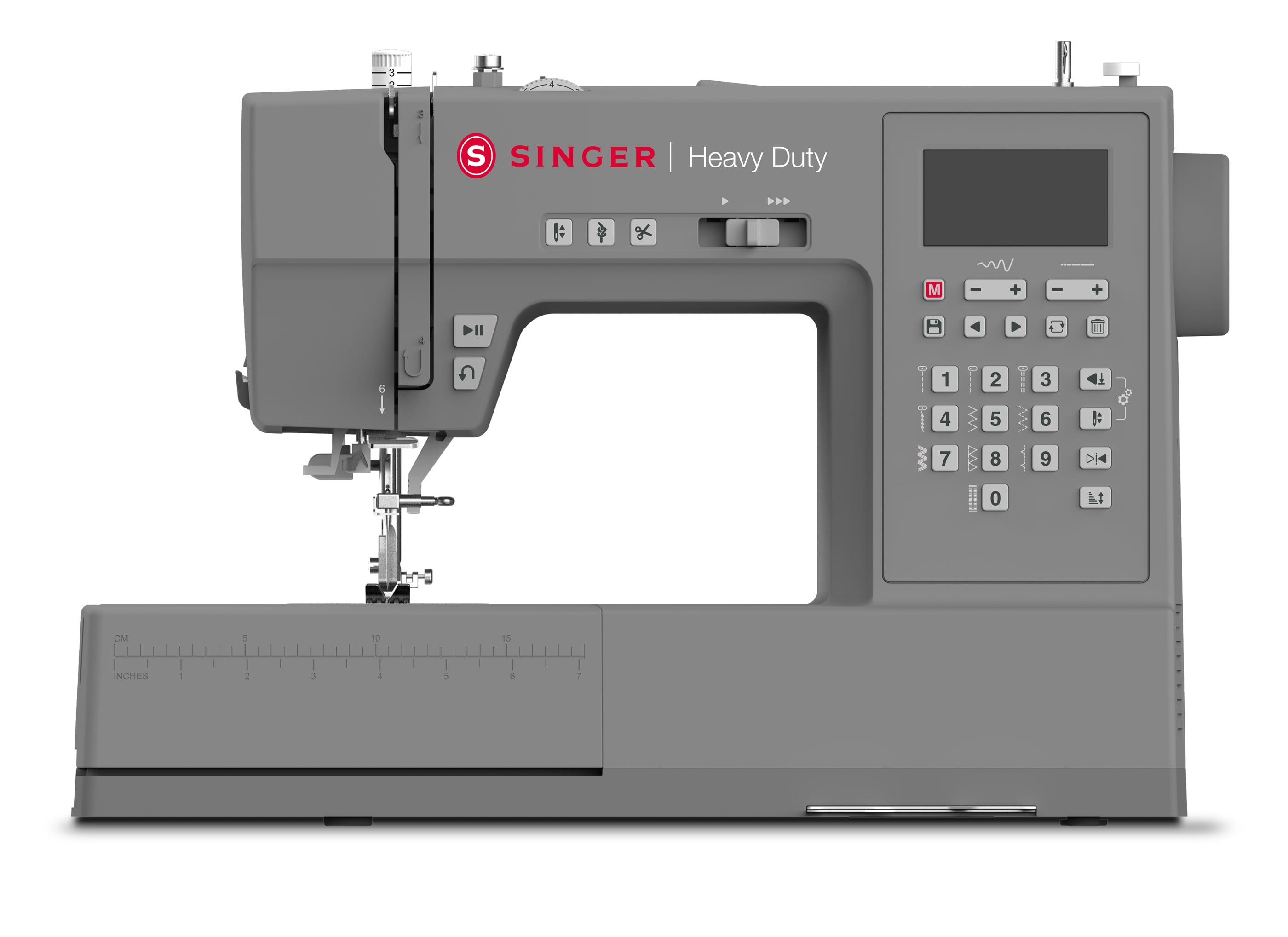
The 6800C is Singer’s answer to the buyer who wants Heavy Duty muscle without giving up modern conveniences. The spec sheet is genuinely impressive for the price: 586 stitch applications spanning basic, stretch, decorative, and quilting stitches, plus lettering fonts for monogramming and labels. The LCD screen shows the selected stitch with recommended settings, and features like mirror imaging and stitch elongation let you customize designs in ways the mechanical 4423 cannot touch.
The convenience features add up in daily use. The thread cutter button trims top and bobbin thread with one press. Needle up/down is programmable. The start/stop button lets you sew without the foot pedal. Ten presser feet come in the box, including a walking foot, which the 4423 lacks. Owners report that for decorative sewing, quilting, and personalization, the 6800C punches far above its price class.
The reliability question is the honest caveat. Computerized machines have circuit boards, and circuit boards are the part that fails when mechanical machines keep going. Owner consensus is that the 6800C is well built for its price, but it has not had the 4423’s decade-plus to prove long-term durability, and a board failure outside warranty is a bigger deal than a mechanical adjustment. This is the fundamental trade-off of the comparison, and it cuts in the 4423’s favor.
Good
✓ 586 stitch applications plus lettering, huge creative range
✓ LCD screen with stitch display and recommended settings
✓ Thread cutter button, needle up/down, start/stop conveniences
✓ 10 presser feet including a walking foot
Watch out for
✕ Roughly double the 4423’s price
✕ Computerized boards are the long-term reliability question mark
✕ More features than a pure beginner needs
Singer Heavy Duty 4423 in Detail

The 4423 is one of the best-selling sewing machines in the world, and it earned that status the boring way: by working. Twenty-three built-in stitches delivering 97 stitch applications, mechanical dial selection, a full metal frame, the 60-percent-stronger motor, and 1,100 spm. It sews denim, canvas, and layered home-decor fabric without complaint, and owners report machines running strong after many years of hard use.
The mechanical simplicity is the feature. There is no screen to fail, no software to glitch, no menu to navigate. You turn a dial, you sew. For beginners, that directness is genuinely easier to learn on than a computerized menu system. For experienced sewists, it means a machine that can be serviced and adjusted for decades. The adjustable presser foot pressure, three needle positions, and drop feed for darning round out a practical package.
What you give up is everything the 6800C adds: decorative variety (97 applications versus 586), lettering, the LCD, one-touch conveniences, and the walking foot (only four feet in the box). If your sewing is mostly construction, repairs, and heavy fabrics rather than decorative work, you will not miss any of it. The 4423 is the machine equivalent of a pickup truck: not fancy, extremely good at its job.
It is also worth noting the 4423’s secondhand market. Because it has been produced for so long and sold in such numbers, used 4423s are plentiful and cheap, and parts are everywhere. A used 4423 from a reputable seller is one of the best sub-$100 sewing values in existence, though for most buyers the new-machine warranty is worth the modest premium.
Good
✓ Proven reliability over more than a decade of production
✓ Mechanical simplicity: no boards to fail, easy to service
✓ Strong motor handles denim and canvas confidently
✓ Excellent value, often under $200
Watch out for
✕ 97 stitch applications versus the 6800C’s 586
✕ No lettering, no LCD, no one-touch conveniences
✕ Only 4 presser feet; walking foot costs extra
Head-to-Head
Stitch quality. Both machines produce good stitches; the Heavy Duty motor and metal frame are shared. The 6800C’s computerized tension and precise stitch formation give it a small edge on decorative stitching, where consistency across a complex pattern matters. On straight stitch and zigzag through heavy fabric, owners report them effectively equal. Neither machine will embarrass you.
Build. Shared Heavy Duty platform: full metal frame, stainless bedplate, strong motor, 1,100 spm. The 6800C adds computerized components to that platform, which is both its advantage (precision, features) and its risk (boards). The 4423’s all-mechanical build is the simpler, more serviceable machine. For pure longevity confidence, the mechanical machine wins.
Features. The 6800C wins by a mile: 586 versus 97 stitch applications, LCD screen, lettering fonts, mirror imaging, stitch elongation, thread cutter button, needle up/down memory, start/stop sewing, and 10 feet versus 4. If your sewing includes decorative work, quilting, or personalization, the feature gap is enormous. If it does not, the gap is irrelevant.
Price. The 4423 wins by a mile: typically $160 to $200 against the 6800C’s $280 to $350. The question is whether the 6800C’s features are worth roughly $120 to $150 extra. For a decorative sewist, absolutely. For someone who sews straight seams through heavy fabric, that money buys a walking foot, quality thread, and needles with change left over.
Verdict: Who Should Buy Which
Buy the Singer 6800C if you want the features: decorative stitching, quilting, monogramming and lettering, the LCD screen, and one-touch conveniences. It is the best feature-per-dollar computerized machine Singer makes, and owners who use the stitch library love it.
Buy the Singer 4423 if you want the workhorse: mechanical reliability, proven longevity, simple operation, and maximum heavy-fabric capability per dollar. It is the machine we recommend to beginners, to heavy-fabric sewists, and to anyone who distrusts circuit boards.
The one-line version: pay more for the computer and the stitches, or pay less for the proven mechanical classic; both are good machines, and the right choice is about your sewing, not the spec sheet.
How We Picked
We compared the two machines within Singer’s own Heavy Duty line because that is exactly how buyers shop them. Reliability was weighted heavily and scored from long-term owner reports: the 4423 benefits from over a decade of production history, while the 6800C is scored on its shorter but positive track record with an explicit note about computerized longevity. Features were scored on breadth and real-world usefulness rather than raw counts. Value was scored as capability per dollar at typical street prices. We verified both Amazon listings directly.
FAQs
Is the 6800C more powerful than the 4423?
No. Both use the Heavy Duty platform with the same class of motor and the same 1,100 spm top speed. The 6800C’s advantages are features and precision, not power.
Which is better for beginners?
The 4423, for most beginners. Mechanical dials are more intuitive than menus when you are learning, and there is less to go wrong. The 6800C suits beginners who are specifically excited by decorative stitching and comfortable with screens.
Can the 4423 handle upholstery-weight fabric?
Light upholstery work, yes: cushion covers, slipcovers, and canvas projects are within its ability, especially with a walking foot added and heavy-duty needles. For a deeper dive, see our upholstery guide linked below.
What does the 6800C’s lettering actually do?
It sews built-in alphabet fonts for monogramming, labels, and personalization. It is not embroidery; the letters are built from the machine’s stitch engine. Fine for names on gifts and quilt labels.
Is a computerized machine harder to repair?
Generally yes. Mechanical issues can be adjusted or fixed with widely available parts; board failures usually mean a professional repair or replacement board. This is the main long-term argument for the 4423.
Should I just get the 4452 instead?
The 4452 sits between these two: same mechanical platform as the 4423 with more stitches (110 applications) and the walking foot included. If you like the 4423’s simplicity but want the extra feet, the 4452 is worth comparing.
Which one holds its value better?
The 4423, by a comfortable margin. Mechanical Singers with long production runs have a deep used market, and buyers trust what they can inspect. Computerized machines depreciate faster because buyers worry about board life. If resale value matters to you, that is another quiet point for the 4423.
Can either machine sew leather?
Light leather and vinyl, occasionally, with a leather needle, a walking foot (included with the 6800C, add-on for the 4423), and patience. Neither is a leather machine for regular work; sustained leather sewing belongs to a walking-foot machine. See our leather guide for the real options.