
As an Amazon Associate I earn from qualifying purchases.
A rotary cutter without a proper cutting mat is like a car without tires. The mat protects your table, keeps your blade sharp, and gives you the printed grid lines you need to cut straight, square pieces. Skimp here and you will pay for it in dull blades and crooked strips.
Every mat on this list is self-healing, which means the surface closes back up after the blade passes through instead of developing permanent grooves. Based on buyer reviews and quilter recommendations, these five mats cover every need from the classic full-size cutting station to the portable rotating mat for squaring blocks.
TL;DR: The Olfa 24″ x 36″ Self-Healing Rotary Mat (~$50-70) is the gold standard for a reason. The Fiskars 24″ x 36″ (~$35-45) gives you nearly the same cutting surface for less. If you square up quilt blocks often, add the Olfa 12″ Rotating Mat (~$35-45).
At a Glance, Our Scores
| Pick | Best for | Our score | Typical price | Buy |
|---|---|---|---|---|
| Olfa 24″ x 36″ Self-Healing Rotary Mat (RM-MG) | Best overall | 9.5/10, the quilter’s standard mat | ~$50-70 | Check Price on Amazon |
| Fiskars 24″ x 36″ Self-Healing Cutting Mat | Best value | 8.9/10, big mat for less money | ~$35-45 | Check Price on Amazon |
| Alvin Professional Self-Healing Cutting Mat (GBM2436) | Best professional | 9.0/10, drafting-grade 5-layer build | ~$40-60 | Check Price on Amazon |
| Olfa 12″ Rotating Cutting Mat (RM-12S) | Best for squaring blocks | 8.8/10, rotate instead of walking around | ~$35-45 | Check Price on Amazon |
| Dahle Vantage 18″ x 24″ Self-Healing Mat | Best portable | 8.5/10, German build, see-through option | ~$25-35 | Check Price on Amazon |
Prices move constantly on Amazon, every “Check Price on Amazon” link below takes you to the live listing.
Quick Picks
- Best overall: Olfa 24″ x 36″ RM-MG, the mat most quilters swear by, ~$50-70.
- Best value: Fiskars 24″ x 36″, same useful size for less, ~$35-45.
- Best professional: Alvin GBM2436, thick drafting-grade mat with green and black sides, ~$40-60.
- Best for squaring blocks: Olfa 12″ Rotating Mat, spins so you never reposition fabric, ~$35-45.
- Best portable: Dahle Vantage 18″ x 24″, sturdy mat for classes and small spaces, ~$25-35.
Detailed Reviews
1. Olfa 24″ x 36″ Self-Healing Rotary Mat (RM-MG), Best Overall
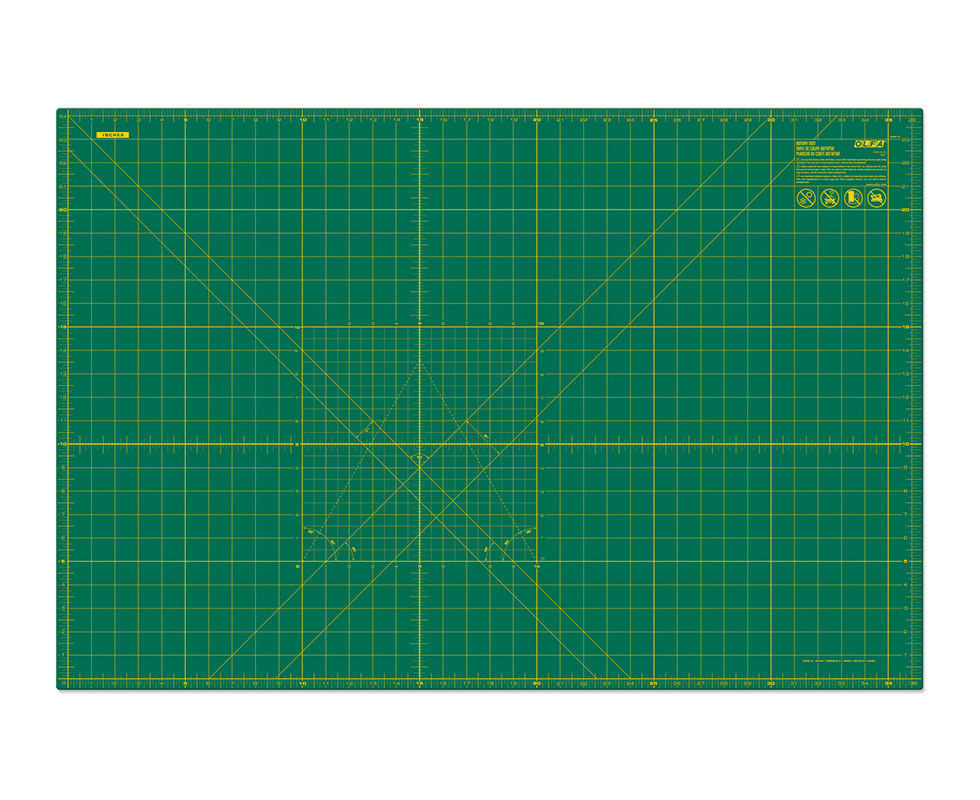
This is the mat you see under the cutting tables of serious quilters everywhere. The 24 by 36 inch size is the sweet spot: big enough to cut full-width fabric folds and long strips without repositioning, but still fits on a standard folding table. It is double-sided, with grid lines on one side and a plain surface on the other for general cutting.
Olfa’s self-healing surface is made with a triple-layer heat-welding process, and owners consistently report it reseals well and lasts for years with normal use. The yellow grid lines on green are easy to read on both light and dark fabrics. Quilting forums treat this mat as the default recommendation, and it is hard to argue with that.
Good
✓ 24×36 is the ideal size for most quilting tasks
✓ Double-sided: gridded on one side, plain on the other
✓ Self-healing surface that owners say lasts for years
✓ High-contrast yellow grid on green, readable on any fabric
✓ Designed specifically for rotary cutters
Watch out for
✕ Premium price compared to budget mats
✕ Must be stored flat and out of sunlight or it can warp
✕ Not for fixed-blade utility knives, which will gouge it
✕ Large size needs a real table, not a TV tray
2. Fiskars 24″ x 36″ Self-Healing Cutting Mat, Best Value
If the Olfa mat is the gold standard, the Fiskars is the smart buy. Same 24×36 size, same double-sided self-healing construction, noticeably lower price. It has clear measuring grids plus 30, 45, and 60-degree bias lines for angle cutting, and the material is flexible enough to store rolled or flat.
Buyer reviews say it cuts well and the grid stays readable. The main trade-off buyers mention is that the self-healing is slightly less robust than Olfa’s under very heavy use, but for typical home quilting it holds up fine. Pair it with a Fiskars cutter and you have a matched set that costs less than the Olfa mat alone.

Good
✓ Full 24×36 cutting area at a budget-friendly price
✓ Double-sided self-healing surface
✓ Grid with inch marks plus 30, 45, and 60-degree bias lines
✓ Flexible material, easy to store
✓ Full lifetime warranty on the mat itself
Watch out for
✕ Self-healing not quite as durable as Olfa under heavy daily use
✕ Thinner than professional drafting mats
✕ Grid printing can fade with years of heavy cutting
✕ Flexible means it needs a flat table underneath
3. Alvin Professional Self-Healing Cutting Mat (GBM2436), Best Professional
Alvin is a drafting-supply company, and its GBM series mats are built like it. This is a 5-layer, 3mm thick mat that is substantially beefier than typical quilting mats. It is green on one side and black on the other, both gridded, which is genuinely useful: use the green side for light fabrics and flip to black for dark ones.
Because it is designed for both rotary blades and straight utility blades, it takes abuse that would scar a thinner mat. Artists and architects have trusted Alvin mats for decades. The trade-off is that 3mm thickness makes it stiffer and heavier, so it is a stay-at-the-table mat, not a class mat.

Good
✓ Thick 5-layer, 3mm construction, extremely durable
✓ Green and black double-sided for light and dark fabrics
✓ Handles rotary and straight blades
✓ 0.5″ grid with 45 and 60-degree angle guides
✓ Professional drafting heritage, trusted for decades
Watch out for
✕ Heavier and stiffer than quilting mats, not portable
✕ 0.5″ grid spacing (not 1″) takes getting used to
✕ Non-glare but the black side shows lint
✕ Overkill if you only cut fabric occasionally
4. Olfa 12″ Rotating Cutting Mat (RM-12S), Best for Squaring Blocks
Squaring up quilt blocks means trimming all four sides, which normally means picking up the block and rotating it three times. This mat rotates instead. It is a two-piece design: a non-slip stationary base with a top cutting layer that spins a full 360 degrees. You cut one side, spin the mat, cut the next.
Owners say it is one of those tools you do not know you need until you try it, then you cannot give it up. The 12×12 size handles most quilt blocks, and it is thin enough to toss in a class tote. Use it alongside your big mat, not instead of it.

Good
✓ Rotates 360 degrees, no more repositioning blocks
✓ Non-slip base stays put while the top spins
✓ Self-healing cutting surface
✓ Thin and light, great for classes and retreats
✓ Grid with 30, 45, 60, and 90-degree markings
Watch out for
✕ 12×12 size is too small as your only mat
✕ Rotation can develop slight play after years of use
✕ Costs as much as some full-size mats
✕ Must still be stored flat
5. Dahle Vantage 18″ x 24″ Self-Healing Mat, Best Portable
Dahle is a German cutting-tool company, and the Vantage line is its premium self-healing mat. The 18×24 size is the classic class-and-retreat size: big enough for real cutting, small enough to carry. It has a 5-layer PVC construction with screened inch, metric, and angled guides.
What makes it stand out is the clear (see-through) option, which is genuinely useful for fussy cutting, centering motifs, and applique placement. Owners report the healing quality is excellent and the mat lies flat. If your cutting mostly happens away from home, this is the mat to pack.

Good
✓ Excellent self-healing 5-layer construction
✓ 18×24 is the ideal portable size
✓ See-through option for fussy cutting and applique
✓ Inch, metric, and angled guides screened on
✓ German build quality, lies flat
Watch out for
✕ Smaller than ideal as your only home mat
✕ Premium price for the size
✕ The clear version shows every mark more visibly
✕ 1/2″ grid may feel busy if you are used to 1″ grids
What Is Self-Healing, Exactly?
A self-healing mat is made from layered material (usually PVC-based) that separates slightly when the blade passes through, then closes back together. The cut disappears instead of becoming a permanent groove. This matters for two reasons: your blade glides smoothly on the next pass instead of catching in old grooves, and your grid lines stay intact and readable far longer.
Cheap mats that claim to be self-healing but are not will develop visible cuts that catch your blade and drag fabric edges. The mats on this list all genuinely heal, which is why quilters keep buying the same brands.
What Size Cutting Mat Do You Need?
24″ x 36″ is the sweet spot for home quilting. It fits a standard folding table, handles full-width fabric folds (quilting cotton is about 42-44″ wide folded, which fits in 36″ with room), and lets you cut long strips without moving the fabric. If you buy one mat, buy this size.
18″ x 24″ is the class mat. Big enough for real projects, small enough to carry to guild meetings, classes, and retreats. Many quilters own both: the big mat lives on the table, the 18×24 travels.
12″ x 12″ rotating mats are a specialty tool for squaring blocks and trimming small pieces. Buy one as a companion to a full-size mat, never as your only mat.
Whatever size you buy, measure your table first. A 24×36 mat on a too-small table hangs over the edge, and cutting on an overhang gives you wobbly, inaccurate cuts.
What to Look For When Buying
- True self-healing construction: Stick with established brands (Olfa, Fiskars, Alvin, Dahle). No-name mats often do not actually heal.
- Size: 24×36 for home, 18×24 for travel, 12×12 rotating for block work.
- Double-sided: Doubles the usable life. Flip the mat when one side gets worn.
- Grid readability: High-contrast grid lines you can see on both light and dark fabric save time and mistakes.
- Thickness: Thicker mats (like the Alvin) last longer but are heavier. Thinner mats are portable but wear faster.
- Storage: Always store flat, away from heat and sunlight. Heat warps mats permanently.
Frequently Asked Questions
How do I make my cutting mat last longer?
Store it flat and out of direct sunlight and heat. Rotate which areas you cut on instead of always using the center. Use the back side when the front gets worn. Never use it as an ironing surface, and never cut on it with a fixed-blade utility knife.
Why is my cutting mat warping?
Heat and sunlight are the usual causes, or storing it rolled, bent, or leaning against something. Lay it flat on a table in a cool room. Minor warping sometimes relaxes out; severe warping from heat is usually permanent.
Can I iron on my cutting mat?
No. Heat damages the self-healing material and can warp it permanently. Iron on an ironing board or pressing mat, not your cutting mat.
How long does a self-healing cutting mat last?
With normal home quilting use, a quality mat lasts several years. Heavy daily use wears one out faster. When the grid becomes unreadable or grooves stop healing and start catching your blade, it is time for a new one.
Do I need a rotating mat if I have a regular mat?
Not strictly, but if you quilt regularly, a rotating mat is one of the most loved specialty tools in the craft. It makes squaring blocks dramatically faster and more accurate. Buy the regular mat first.
Can I cut paper on my fabric cutting mat?
You can, but paper dulls rotary blades fast, so most quilters keep a separate cheap mat or an old mat for paper and craft cuts. Keep your good mat for fabric only.