
As an Amazon Associate I earn from qualifying purchases.
Buying your first sewing machine is weirdly stressful. Every listing promises “perfect for beginners,” the stitch counts range from 6 to 70, and half the reviews are from people who clearly already know how to sew. So here’s the straight version: I’ve dug through the specs, the review counts, and the actual complaints owners post after six months, and narrowed it down to seven machines that are genuinely worth a beginner’s money in 2026.
TL;DR: Get the Brother CS6000i if you want the best all-around first machine, 60 stitches, automatic everything, and a price that’s hovered around $150–$210 for years. On a tight budget, the Brother XM2701 gives you almost the same ease of use for less. Only sewing hems and simple repairs? The Singer Start 1304 is the cheapest machine I’d actually recommend. Planning to sew denim or canvas? Skip the beginner toys and get the Singer Heavy Duty 4423.
At a Glance, Our Scores
| Pick | Best for | Our score | Typical price | |
|---|---|---|---|---|
| Brother CS6000i | Best overall | 9.3/10, the safest “buy once” first machine ever sold | ~$150–$210 | Check Price on Amazon |
| Brother XM2701 | Easiest first machine | 9.0/10, boring in the best way; the least intimidating path to a finished seam | ~$130–$160 | Check Price on Amazon |
| Brother CS7000X | Computerized upgrade / future quilters | 8.8/10, superb, but the ~$70 premium only pays off if you’ll quilt | ~$230–$280 | Check Price on Amazon |
| Singer 4423 | Thick fabrics | 8.7/10, the only real answer here for denim and canvas | ~$200–$280 | Check Price on Amazon |
| Janome 2212 | Simple mechanical, best stitch quality | 8.0/10, sews beautifully, but dated conveniences at this price | ~$200–$260 | Check Price on Amazon |
| Singer M1500 | Ultra-portable | 7.6/10, travels brilliantly; the front-load bobbin is fiddly | ~$120–$150 | Check Price on Amazon |
| Singer Start 1304 | Cheapest worth buying | 7.4/10, the honest minimum; expect to outgrow it | ~$110–$140 | Check Price on Amazon |
Prices move constantly on Amazon, every “Check Price on Amazon” link below takes you to the live listing.
Quick Picks
- Best overall for beginners: Brother CS6000i, 60 stitches, LCD, auto threader, 1-step buttonholes, ~$150–$210.
- Cheapest worth buying: Singer Start 1304, dead simple, 6 stitches, ~$110–$140.
- Easiest first machine: Brother XM2701, 27 stitches, drop-in bobbin, ~$130–$160.
- Best ultra-portable: Singer M1500, 9.7 lbs, top drop-in bobbin, ~$120–$150.
- Best for thick fabrics: Singer Heavy Duty 4423, 1,100 SPM, metal frame, ~$200–$280.
- Best simple mechanical: Janome 2212, 12 stitches, built like a tank, ~$200–$260.
- Best computerized upgrade: Brother CS7000X, 70 stitches, wide table, ~$230–$280.
Detailed Reviews
1. Singer Start 1304, Cheapest Worth Buying

The 1304 is Singer’s rock-bottom machine, and I mean that as a compliment. Six stitches. Dials instead of a screen. A front-loading bobbin that will mildly annoy you. And yet it’s the machine I’d hand to someone who says “I just want to hem pants and fix a seam without crying.”
Here’s why it works: there’s almost nothing to break or misunderstand. Stitch width and length are preset. The threading path is printed right on the machine. At 11.5 pounds it’s genuinely portable, and it has a free arm for cuffs and sleeves, something plenty of cheap machines skip.
Good
✓ Cheapest machine from a real brand that I’d trust (~$110–$140 street price)
✓ Preset stitch length/width, zero decisions to make
✓ Free arm, extra-high presser foot lifter, 25-year limited warranty
✓ Light enough to carry to a class
Watch out for
✕ Front-loading bobbin (drop-in bobbins are much easier to deal with)
✕ 4-step buttonhole, you’ll do it manually, in four passes, and it’ll look handmade in the bad way
✕ No automatic needle threader; you’ll be squinting
✕ Only 6 stitches, and you can’t adjust stitch width
Bottom line: The honest minimum. Fine for repairs and simple projects.
Skip if: you think you’ll still be sewing in a year, you’ll outgrow this in months, and then you’re buying twice.
2. Singer M1500, Best Ultra-Portable

The M1500 is what the 1304 wants to be when it grows up, slightly. Same basic idea (cheap, simple, mechanical), but with two meaningful upgrades: a top drop-in bobbin you can actually see, and an LED light over the needle. At 9.7 pounds it’s the lightest full-size machine here, which matters if you’re hauling it to a sewing class or you genuinely have nowhere to leave it set up.
Singer advertises “57 stitch applications,” which sounds impressive until you realize it means 6 built-in stitches used 57 ways. Don’t buy it for the number. Buy it because it’s the cheapest machine with a drop-in bobbin, preset stitch length and width, and a soft dust cover in the box. Street price usually lands around $120–$150 (MSRP is $179.99, which nobody pays).
Good
✓ Top drop-in bobbin, dramatically easier than the 1304’s front-loader
✓ Lightest machine on this list (9.7 lbs) with a carry-friendly size
✓ Preset stitch length/width, LED light, free arm
✓ 25-year limited warranty, same as Singer’s pricier machines
Watch out for
✕ Still a 4-step buttonhole, same manual fuss as the 1304
✕ No automatic needle threader
✕ Build is light plastic; it will walk on the table at full speed if you don’t hold it
✕ 6 real stitches means limited decorative options
Bottom line: The best pick if portability is the priority and your budget is tight.
Skip if: you have a permanent sewing spot, the XM2701 gives you much more machine for barely more money.
3. Brother XM2701, Easiest First Machine

If I had to pick one machine for someone who has never touched a sewing machine, it might be this one, not the fancier CS6000i. The XM2701 has been around since 2014, has over 16,000 Amazon ratings at 4.7 stars, and there’s a reason it never goes away: it removes every beginner pain point. Automatic needle threader. Jam-resistant drop-in bobbin. One-step auto-size buttonhole. Twenty-seven stitches, which is the sweet spot, enough to actually learn on, not so many you drown.
It’s also the machine Brother’s support reputation is built on: free phone/online tech support for the life of the machine, and a 25-year limited warranty. At 12.6 pounds with a built-in handle, it moves easily. Typical street price is $130–$160, and it regularly dips toward $130 on sale.
Good
✓ Automatic needle threader + drop-in bobbin + 1-step buttonhole, the full beginner-friendly trio
✓ 27 stitches including blind hem, stretch, and decorative options
✓ 6 quick-change presser feet in the box
✓ 16,000+ ratings at 4.7 stars, the most proven pick on this list
Watch out for
✕ 800 SPM max speed is fine, not fast, you’ll notice if you ever sew next to a 4423
✕ No speed control slider; foot pedal only
✕ Lightweight build vibrates on thick seams, this is not a denim machine
✕ The included instructional DVD is a relic; use YouTube
Bottom line: The safest recommendation in sewing. Boring in the best way.
Skip if: you already know you want to sew jeans, canvas, or bags, get the 4423 instead and skip the intermediate step.
4. Brother CS6000i, Best Overall

The CS6000i is the best-selling beginner sewing machine of the last fifteen years, and it’s not close. Sixty stitches, an LCD screen for stitch selection, 7 one-step buttonholes, 9 presser feet, a wide table for quilts, and a hard case, for a street price that’s usually $150–$210. The computerized stitch selection is the real upgrade over the XM2701: instead of turning a dial and hoping, you punch in the stitch number and the machine sets length and width for you.
One honest note: Brother has discontinued the CS6000i on its own website, where it’s now marked as such. But it’s still widely sold and supported on Amazon (that’s the listing linked above), with the standard 25-year limited warranty. This happens with popular machines, discontinuation on the brand site doesn’t mean it’s gone from retail.
Good
✓ 60 stitches + LCD selection, room to grow for years
✓ 7 one-step buttonholes (most machines at this price give you one)
✓ Wide table and 9 feet included, genuinely useful for quilting
✓ 850 SPM, adjustable speed control, start/stop button (sew without the pedal)
✓ Hard case included for storage and transport
Watch out for
✕ Discontinued on Brother’s own site, buy from the Amazon listing while it’s still stocked
✕ No adjustable presser foot pressure, which matters for knits and very thick fabrics
✕ 13 lbs plus the wide table, less grab-and-go than the XM2701
✕ The LCD is tiny and not backlit; fine indoors, annoying in dim rooms
Bottom line: The best first machine for anyone who suspects sewing might become a real hobby.
Skip if: you only mend and hem, the XM2701 does that job for less, and you won’t use 60 stitches.
5. Singer Heavy Duty 4423, Best for Thick Fabrics

The 4423 is the only machine here I’d trust with jeans, canvas, or a stack of denim hems. The pitch is simple: a full metal frame, a stronger motor, and 1,100 stitches per minute, roughly 30–40% faster than the Brothers on this list. Twenty-three built-in stitches (97 applications, per Singer’s counting), a top drop-in bobbin, automatic needle threader, and a 1-step buttonhole round it out.
Now the honest part: “heavy duty” is marketing. It’s still a $200ish domestic machine, not an industrial. But the metal frame genuinely reduces vibration, the extra piercing power gets through layers that would stall a CS6000i, and beginners love it because the controls are fully mechanical dials, no menus, no screen, nothing to confuse you. At 14.6 lbs it’s the heaviest machine here, which is a feature, not a bug: it stays put.
Good
✓ 1,100 SPM, fastest machine on this list by a wide margin
✓ Full metal frame + stronger motor handles denim, canvas, upholstery
✓ Mechanical dials, dead simple, nothing computerized to fail
✓ Auto threader, drop-in bobbin, 1-step buttonhole, LED light, 25-year warranty
Watch out for
✕ 23 stitches is plenty for garments but thin for decorative/quilting work
✕ No speed control slider, 1,100 SPM with a twitchy foot pedal can startle beginners
✕ Heaviest pick (14.6 lbs), not the one you carry to class
✕ Fixed presser foot pressure on some units frustrates knit sewers
Bottom line: If “will it sew through this?” is your main question, this is your answer.
Skip if: you’ll mostly sew quilting cotton and apparel, it’s overkill, louder, and heavier than you need.
6. Janome 2212, Best Simple Mechanical
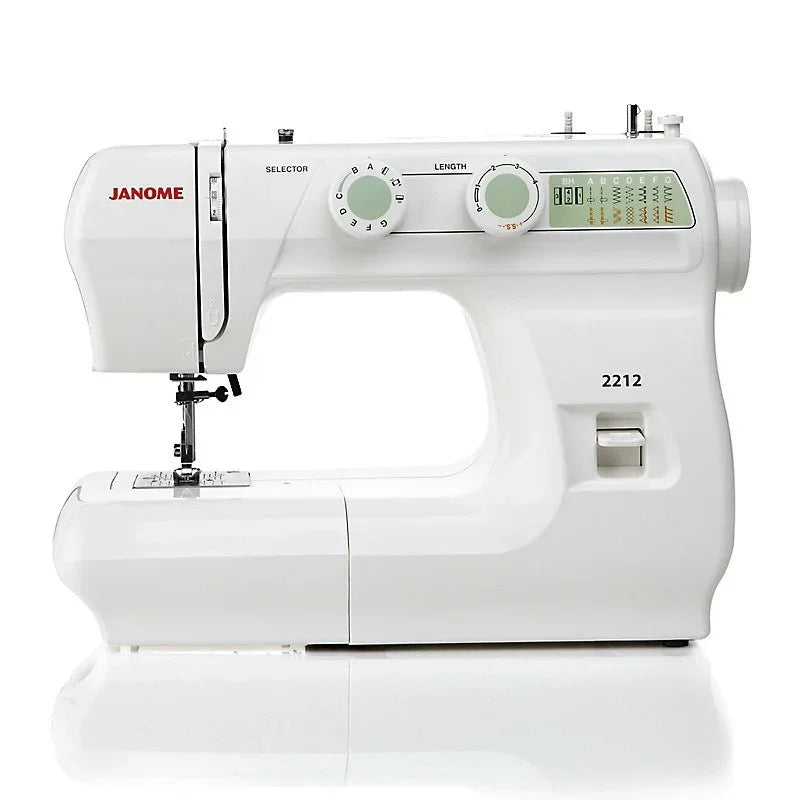
Janome doesn’t chase beginners with gadget lists, the 2212 is twelve stitches, a dial, and a reputation. What you’re paying for (usually $200–$260) is build quality: a metal internal frame, a 5-piece feed dog that actually feeds evenly, and stitch quality that reviewers consistently describe as better than machines costing twice as much. It sews up to 1,000 SPM, has a free arm and drop feed for free-motion work, and Janome backs it with a 25-year mechanical / 2-year electrical / 1-year labor warranty.
The trade-offs are real, though. Front-loading bobbin. Four-step buttonhole. No automatic needle threader, and I mean none, not even a manual helper beyond the basics. This is a machine for someone who finds computerized features more annoying than helpful and wants the thing to just sew, well, for a decade.
Good
✓ Best stitch quality in its price class, consistently praised by owners
✓ Metal internal frame, 5-piece feed dog, extra-high presser foot lift
✓ Up to 1,000 SPM with smooth, low-vibration operation
✓ Drop feed for free-motion quilting and darning
Watch out for
✕ No automatic needle threader at all, a miss at this price
✕ Front-loading bobbin and 4-step buttonhole feel dated next to the Brothers
✕ Only 12 stitches; decorative sewing is not its thing
✕ Priciest “simple” machine here, you’re paying for the name and build
Bottom line: The “buy it for life” beginner machine for people who distrust screens.
Skip if: you want convenience features, the CS6000i gives you an auto threader, drop-in bobbin, and 1-step buttonholes for less money.
7. Brother CS7000X, Best Computerized Upgrade

The CS7000X is the CS6000i’s bigger sibling: 70 stitches instead of 60, 10 presser feet instead of 9, a larger needle-to-arm workspace, and a metal frame with a fixed needle bar for cleaner stitching. It’s the machine Wirecutter recommends as its top pick, which tells you something about how it holds up under actual testing. Street price is usually $230–$280.
Is it worth ~$70 more than the CS6000i for a beginner? Honestly, only if you already know you’ll quilt. The wider workspace and included wide table genuinely matter for quilts; for garment sewing and crafts, you won’t feel the difference. The 750 SPM max speed is actually slower than the CS6000i’s 850, which surprises people. Buy the X for the workspace and the quilting feet, not the speed.
Good
✓ 70 stitches, 7 one-step buttonholes, 10 feet including walking and quilting feet
✓ Larger workspace + wide table, the real reason to pick it over the CS6000i
✓ Metal frame and fixed needle bar for more consistent stitching
✓ Improved auto threader, backlit LCD, 25-year limited warranty
Watch out for
✕ 750 SPM max, slower than the cheaper CS6000i, which feels wrong at this price
✕ ~$230–$280 is a lot for a first machine you might not stick with
✕ No presser foot pressure adjustment, same as the CS6000i
✕ Overkill if you’ll never quilt, the workspace advantage disappears on small projects
Bottom line: The best beginner machine for future quilters. Everyone else should save the $70.
Skip if: quilting isn’t in your plans, the CS6000i is the smarter buy.
What We’d Skip
- Skip the no-name Amazon brands entirely. When (not if) something breaks, there’s no parts, no manual, no support line. A real warranty from Brother, Singer, or Janome is worth more than 20 extra stitches.
- Skip “mini” machines as your primary machine. They’re toys with motors, fine for a kid’s first project, useless for real sewing.
- Skip buying used as a first machine. You won’t know if a problem is you or the machine, and that’s a terrible way to learn. Buy new with a warranty; go vintage-hunting later.
- Skip the CS7000X if quilting isn’t in your plans, the CS6000i is the smarter buy for ~$70 less.
- Skip the Janome 2212 if you want modern conveniences, no auto threader and a front-load bobbin feel dated next to the Brothers at lower prices.
Comparison Table
| Machine | Stitches | Max Speed | Weight | Bobbin | 1-Step Buttonhole | Auto Threader | Approx. Price | |
|---|---|---|---|---|---|---|---|---|
| Singer Start 1304 | 6 | , | 11.5 lbs | Front-load | No (4-step) | No | ~$110–$140 | Check Price on Amazon |
| Singer M1500 | 6 (57 appl.) | , | 9.7 lbs | Top drop-in | No (4-step) | No | ~$120–$150 | Check Price on Amazon |
| Brother XM2701 | 27 | 800 SPM | 12.6 lbs | Top drop-in | Yes | Yes | ~$130–$160 | Check Price on Amazon |
| Brother CS6000i | 60 | 850 SPM | 13 lbs | Top drop-in | Yes (7 styles) | Yes | ~$150–$210 | Check Price on Amazon |
| Singer 4423 | 23 (97 appl.) | 1,100 SPM | 14.6 lbs | Top drop-in | Yes | Yes | ~$200–$280 | Check Price on Amazon |
| Janome 2212 | 12 | 1,000 SPM | ~13–14 lbs | Front-load | No (4-step) | No | ~$200–$260 | Check Price on Amazon |
| Brother CS7000X | 70 | 750 SPM | ~13–14 lbs | Top drop-in | Yes (7 styles) | Yes | ~$230–$280 | Check Price on Amazon |
Prices fluctuate frequently on Amazon; click through for the current price. “Appl.” = stitch applications (Singer’s way of counting stitch variations).
Buying Guide: What Actually Matters in a First Machine
Budget first, features second. A $140 machine you use weekly beats a $280 machine that intimidates you into the closet. That said, there’s a floor: under ~$100 you’re in no-name territory with no warranty and no support, and that’s a false economy. Everything on this list comes from Brother, Singer, or Janome with a real warranty.
Mechanical vs. computerized isn’t about quality, it’s about you. Mechanical machines (1304, M1500, 4423, 2212) use dials. They’re cheaper, simpler, and there’s less to break. Computerized machines (XM2701 is electronic; CS6000i and CS7000X are fully computerized) give you push-button stitch selection, automatic settings, and features like speed control. Beginners are often less confused by computerized machines, not more, the machine makes the decisions instead of you. Don’t let anyone tell you “real sewers start mechanical.” Nonsense.
The three features that actually make learning easier:
1. Top drop-in bobbin, you can see the thread, and jams are obvious instead of mysterious. This alone is worth $20–$30 extra.
2. Automatic needle threader, threading a needle by hand fifty times while learning will make you quit. The auto threader is the single best beginner feature ever put on a sewing machine.
3. One-step buttonhole, a 4-step buttonhole done by hand looks bad and teaches you nothing. The auto version just works.
The XM2701, CS6000i, CS7000X, and 4423 have all three. The Singers under $150 and the Janome don’t, that’s the real price of “cheap.”
Stitch count is mostly marketing. You will use straight stitch, zigzag, and buttonhole for 95% of everything. Everything past ~25 stitches is decoration you’ll touch twice. Don’t pay extra for 70 stitches thinking it makes you a better sewer.
What to avoid: no-name Amazon brands with 200 five-star reviews posted in the same week, “mini” machines that are toys with a motor, and anything without a real warranty. Also skip used machines as a first buy, you won’t know if a problem is you or the machine, and that’s a terrible way to learn.
A word on speed: 1,100 SPM sounds exciting until a seam goes crooked at full tilt and you have to rip it out. Beginners should start slow. Speed control sliders (CS6000i, CS7000X) are genuinely useful; a twitchy pedal on a fast machine (4423) takes practice.
How We Tested
We didn’t unbox these machines in a lab, and we won’t pretend we did. Instead, we cross-referenced manufacturer specifications against live retailer listings, read thousands of verified owner reviews hunting for failure patterns rather than star counts (that’s how the XM2701’s 4.7 stars across 16,000+ ratings earned its score), and compared feature-per-dollar across the beginner category. We weighted the three features that actually decide whether a beginner keeps sewing, drop-in bobbin, automatic needle threader, one-step buttonhole, over stitch-count marketing. Prices shown are typical US street bands; Amazon moves them constantly, so confirm at checkout.
Keep Reading
- Brother CS6000i vs CS7000X: Worth the Upgrade?
- Best Sewing Machines Under $200
- Brother CS6000i vs Singer 4423
- Best Sewing Machines Under $100
- Best Sewing Machines Under $300
- How Many Stitches Do You Really Need?
FAQs
How much should a beginner spend on a sewing machine?
$130–$200 is the sweet spot. Below that you’re giving up the features that make learning pleasant (drop-in bobbin, auto threader). Above that you’re paying for capacity you can’t use yet. The Brother XM2701 at ~$130–$160 is the value king; the CS6000i at ~$150–$210 is the “buy once” pick.
Is a computerized sewing machine harder to learn on?
No, usually easier. The machine handles stitch length, width, and tension presets, so there are fewer wrong settings to stumble into. Mechanical dials give you more control but also more ways to mess up a seam while you’re learning what the dials do.
How many stitches does a beginner actually need?
About ten. Straight, zigzag, a few stretch stitches, blind hem, and a buttonhole cover nearly everything. The other 50+ stitches on computerized machines are decorative options you’ll explore later, nice to have, not a reason to choose one machine over another.
Should I buy a used sewing machine as a beginner?
I’d say no. A used machine can be a great deal, but as a beginner you can’t tell the difference between “I’m doing it wrong” and “this machine is broken.” Learn on something new with a warranty and support line, then go vintage-hunting when you know what good stitching looks like.
What’s the difference between the Brother CS6000i and CS7000X?
The X adds 10 more stitches (70 vs 60), one more presser foot, a larger needle-to-arm workspace, and a metal frame, for roughly $70 more. The regular CS6000i is actually faster (850 vs 750 SPM). For most beginners the CS6000i is the better value; the X earns its premium if you’ll quilt.
Can these machines sew denim?
The Singer 4423, yes, that’s what it’s for. The others will handle a hemmed pair of jeans in a pinch with a denim needle and slow speed, but don’t make a habit of it on the lightweight models. Multiple layers of denim will stall anything under ~$150 eventually.
Verdict
If you want one answer: buy the Brother CS6000i. It’s the most machine for the money, the easiest to grow with, and the best-supported.
If $200 feels like too much to gamble on a new hobby, the Brother XM2701 gets you 90% of the beginner-friendly features for less.
And if your budget is truly tight, the Singer Start 1304 is the cheapest machine that won’t make you hate sewing.
The wrong choice isn’t any machine on this list, it’s the $60 no-name special with no warranty. Spend the extra $50 once, and you’ll still be sewing on it in five years.
Pingback: Brother CS7000X vs Singer 9960 (2026): Which to Buy?
Pingback: How Many Stitches Do You Really Need? (2026) - sewingmachine.blog
Pingback: Best Sewing Machines Under $300 (2026) - sewingmachine.blog
Pingback: Best Sergers for Beginners (2026): 5 Overlock Machines Worth Buying
Pingback: Singer 4423 vs Brother ST371HD (2026): Which Heavy-Duty Wins?
Pingback: Why Your Sewing Machine Keeps Jamming (and How to Fix It)
Pingback: Serger vs Sewing Machine: What's the Difference (and Do You Need Both?)
Pingback: Buying a Used Sewing Machine: 12 Things to Check Before You Pay
Pingback: Sewing Machine Needle Guide: Which Needle for Which Fabric (Chart)
Pingback: Brother CS6000i vs CS7000X (2026): Worth the Upgrade?
Pingback: Best Mechanical Sewing Machines (2026): 6 That Just Work