
As an Amazon Associate I earn from qualifying purchases.
There’s a moment in every sewer’s life when the beginner machine starts feeling small. The projects get bigger, the fabrics get thicker, the buttonholes need to look professional, or the embroidery curiosity becomes impossible to ignore. That’s the moment this list is for. Under $500 is where sewing machines stop being “starter” machines and start being serious tools, metal frames, real speed, hundreds of stitches, embroidery capability, and build quality that lasts decades.
One honest note before we start: a few machines on this list hover right around the $500 line, sometimes a little above it at regular price, dipping under during sales. I’ve marked those clearly. Street prices on machines this expensive move constantly, so treat every price band as “verify before you buy” rather than gospel.
TL;DR: The Brother HC1850 (~$280–$300) is the value king, 185 stitches and a wide table for the price of a beginner machine. The Brother CS7000X (~$230–$280) is the budget anchor that punches above its price. The Juki HZL-LB5100 (~$450–$600) is the precision pick, superb stitch quality when found under $500. The Singer 9960 (~$500–$550) is the feature monster, 600 stitches and lettering, frequently dipping under $500 on sale. The Brother SE700 (~$500–$540) is the cheapest real path into embroidery. The Janome HD3000 (~$470–$530) is the buy-it-for-life mechanical workhorse.
At a Glance, Our Scores
| Pick | Best for | Our score | Typical price | |
|---|---|---|---|---|
| Brother HC1850 | Best value overall | 9.0/10, 185 stitches, wide table, unbeatable price | ~$280–$300 | Check Price on Amazon |
| Brother CS7000X | Budget computerized | 8.8/10, the $250 machine that sews like $400 | ~$230–$280 | Check Price on Amazon |
| Juki HZL-LB5100 | Precision stitching | 8.9/10, Juki build quality, superb stitch formation | ~$450–$600* | Check Price on Amazon |
| Singer 9960 | Maximum features | 8.6/10, 600 stitches, lettering, 13 buttonholes | ~$500–$550* | Check Price on Amazon |
| Brother SE700 | Embroidery on a budget | 8.4/10, the cheapest real sew-plus-embroidery combo | ~$500–$540* | Check Price on Amazon |
| Janome HD3000 | Buy-it-for-life mechanical | 9.1/10, aluminum body, the last machine you’ll need | ~$470–$530* | Check Price on Amazon |
*Hovers around $500, regularly dips under during sales. Verify the live price before buying.
Prices move constantly on Amazon, every “Check Price on Amazon” link below takes you to the live listing.
Quick Picks
- Best value: Brother HC1850, 185 stitches, LCD, wide table, ~$280–$300.
- Budget computerized: Brother CS7000X, 70 stitches, quilting-ready, ~$230–$280.
- Precision pick: Juki HZL-LB5100, 100 stitches, 7-point feed, ~$450–$600.
- Feature monster: Singer 9960, 600 stitches, 5 fonts, 13 buttonholes, ~$500–$550.
- Embroidery entry: Brother SE700, 135 designs, 4×4 hoop, wireless, ~$500–$540.
- Mechanical for life: Janome HD3000, 18 stitches, die-cast aluminum, ~$470–$530.
Detailed Reviews
1. Brother HC1850, Best Value Overall

The HC1850 is the most machine per dollar on this list, and it’s not close. One hundred eighty-five built-in stitches, an LCD screen, 8 one-step buttonhole styles, 55 alphanumeric stitches for monogramming, automatic needle threader, drop-in bobbin, and a wide table included in the box, for around $280 to $300. That’s a mid-range feature set at a beginner-machine price, and it’s why this machine has over 5,000 Amazon ratings at 4.5 stars.
TechGearLab named it their best overall sewing machine for most people, which is remarkable for a machine this cheap, and the reason is usability. The computerized stitch selection is genuinely easy, the LCD is clear, and the machine handles the full range of everyday sewing, garments, quilting, home decor.
The honest caveats: it’s light enough to vibrate and walk on the table at high speeds (a mat fixes this), the needle threader gets mixed reviews from owners with larger hands, and the throat space is modest for big quilts. But at $280, you’re getting 90% of what the $500 machines offer. For most upgraders, this is the rational stopping point.
Good
✓ 185 stitches plus 55 alphanumeric, huge creative range for the price
✓ LCD stitch selection, genuinely easy to use
✓ Wide table included free, great for quilting
✓ 4.5 stars from 5,000+ owners, widely recommended by reviewers
✓ Free lifetime Brother tech support
Watch out for
✕ Lightweight build vibrates at high speed, use a mat underneath
✕ Needle threader gets mixed reviews, fiddly for larger hands
✕ Modest throat space, very large quilts are awkward
Bottom line: The value king. Most upgraders should start here and only spend more for a specific reason.
Skip if: you need heavy-fabric power or embroidery, this is a versatility pick, not a specialist.
2. Brother CS7000X, Best Budget Computerized

The CS7000X is the cheapest machine on this list and one of the best values in all of sewing. Seventy stitches, 7 one-step buttonholes, 10 presser feet including walking and quilting feet, a larger needle-to-arm workspace than its little brother, a metal frame with a fixed needle bar, and a wide table, for $230 to $280. It’s the machine Wirecutter recommends as its top pick, which tells you how it holds up under serious testing.
The X’s real strength is quilting readiness. The wider workspace and included wide table matter enormously for quilts, and the walking foot (included, not a $30 add-on) is the difference between puckered quilts and flat ones. For garment sewing and crafts, it’s simply a very good computerized machine with easy stitch selection and reliable operation.
The quirks are well documented: 750 SPM max speed (slower than the cheaper CS6000i’s 850, oddly), no presser foot pressure adjustment, and a feature set that’s generous but not exceptional. But as the budget anchor of the mid-range, it’s superb, a machine that sews like it costs $400.
Good
✓ 70 stitches, 7 buttonholes, 10 feet including walking foot, all included
✓ Larger workspace plus wide table, genuinely quilting-ready
✓ Metal frame and fixed needle bar for consistent stitching
✓ Wirecutter’s top pick, extensively tested
✓ 25-year limited warranty
Watch out for
✕ 750 SPM max, slower than cheaper Brothers, feels wrong at first
✕ No presser foot pressure adjustment
✕ The value is in quilting, for pure garment sewing the HC1850 gives more stitches per dollar
✕ Backlit LCD is small
Bottom line: The $250 machine that sews like $400. The smart buy for quilters on a budget.
Skip if: quilting isn’t your thing, the HC1850’s 185 stitches are more useful for garment and craft sewers.
3. Juki HZL-LB5100, Best Precision Pick

Juki is the brand serious sewers whisper about. The company makes industrial machines, and the HZL-LB5100 brings some of that DNA to a home machine: 100 built-in stitches, a 7-point feed dog system (most home machines have fewer feed points, which means less even feeding), an automatic needle threader, LCD screen, drop-in bobbin, and stitch quality that owners describe as a visible step above consumer brands. The 7-point feed is the headline feature, it grips fabric more evenly, which shows up as straighter seams and happier quilting.
The specs are modest on paper: 700 SPM max speed (slower than the Brothers and Singers here), one-step buttonhole, 12.3 pounds. But Juki buyers aren’t buying specs, they’re buying stitch formation, and by every account, the LB5100 delivers. It’s the machine for the sewer who’s noticed that their current machine’s stitches look “fine” and wants them to look perfect.
The price is the complication. List is $599, street price from marketplace sellers usually lands between $450 and $600, which means it’s sometimes under $500 and sometimes not. At under $500 it’s an excellent buy. Over $500, you’re paying a premium for the Juki name that only makes sense if precision is your priority. Watch the price and buy the dip.
Good
✓ 7-point feed dog, visibly better fabric feeding than standard machines
✓ Superb stitch quality, the reason to buy Juki
✓ 100 stitches, auto threader, LCD, drop-in bobbin, the essentials done well
✓ 12.3 lbs, solid but portable
✓ Industrial-brand engineering in a home machine
Watch out for
✕ 700 SPM max, the slowest machine on this list
✕ Price hovers around $500, often sold by marketplace sellers, not Amazon direct
✕ Only 100 stitches, you’re paying for quality, not quantity
✕ 5-year parts warranty is shorter than Brother/Singer/Janome’s 25-year terms
Bottom line: The precision pick. When found under $500, it’s the best-stitching machine on this list.
Skip if: you want features per dollar, the HC1850 gives you nearly twice the stitches for half the price.
4. Singer 9960 Quantum Stylist, Maximum Features

The 9960 is the feature monster of the mid-range: 600 built-in stitches, 1,172 stitch applications, 13 one-step buttonhole styles, 5 lettering fonts, mirror imaging, stitch elongation, automatic threader, push-button thread cutter, speed control, start/stop button, and an extension table with 13 presser feet in the box. No other machine under $600 offers this much stuff. Street price is usually $500 to $550, with regular dips under $500 during sales.
The question is whether you’ll use it. Six hundred stitches is genuinely useful for decorative sewing, heirloom work, and monogramming, and the lettering fonts are a real differentiator, no other machine here does built-in lettering. But for garment construction and quilting, most of those 600 stitches will never leave the menu. You’re paying for breadth, and breadth is only worth it if your sewing is broad.
Owner sentiment is strong (4.2 stars from 9,000+ ratings), with the usual computerized-machine themes: a learning curve proportional to the feature count, occasional thread-pickiness, and a black-and-white LCD that feels dated. But as a creative tool for someone who’ll explore the stitch library, it’s unmatched at this price. Wait for the sub-$500 sale, it happens regularly.
Good
✓ 600 stitches, 13 buttonholes, 5 fonts, the biggest feature set under $600
✓ Built-in lettering, unique at this price
✓ Thread cutter, speed control, start/stop, extension table, 13 feet, all included
✓ Still in production with full warranty and parts support
✓ 9,000+ ratings, deeply documented by the owner community
Watch out for
✕ Usually $500–$550, the value depends on catching the sub-$500 sale
✕ Dated black-and-white LCD
✕ 600 stitches is overwhelming if you won’t use them
✕ Picky about thread quality, cheap thread causes jams
Bottom line: The most machine for the money if you’ll use the stitch library. Buy it on sale under $500.
Skip if: you sew garments and quilts, not decorative work, the HC1850 does your jobs for half the price.
5. Brother SE700, Best Embroidery Entry

The SE700 is the cheapest real path into machine embroidery: a combination sewing and embroidery machine with 135 built-in embroidery designs, 10 embroidery lettering fonts, 103 sewing stitches, 10 one-step buttonholes, a 4×4-inch embroidery field, wireless LAN connectivity, and a 3.7-inch color touchscreen. Street price is usually $500 to $540, which makes it the most expensive machine on this list, but it’s also two machines in one.
The embroidery math is what matters. A dedicated embroidery-only machine at this price doesn’t exist from a major brand, the cheapest real embroidery machines start around $400–$500 anyway, and they can’t sew. The SE700 sews (103 stitches is plenty) and embroiders (4×4 hoop covers monograms, patches, shirt pockets, baby clothes), with wireless transfer of designs from your computer via Brother’s free software.
The limitations are the embroidery limitations: 4×4 hoop is small (you’ll want bigger within a year if embroidery becomes serious), the learning curve for embroidery (stabilizers, hooping, thread) is real, and at $500+ it’s the priciest pick here. But if embroidery is the goal, this is the entry ticket, and it’s a good one.
Good
✓ 135 embroidery designs plus 103 sewing stitches, two machines in one
✓ Wireless LAN design transfer, no USB shuffling
✓ 3.7-inch color touchscreen, easy design preview and editing
✓ 4.4 stars, strong and current buyer demand
✓ The cheapest real embroidery entry from a major brand
Watch out for
✕ Usually $500–$540, the priciest pick, watch for sub-$500 sales
✕ 4×4 hoop is small, serious embroiderers outgrow it
✕ Embroidery has a real learning curve (stabilizers, hooping technique)
✕ As a pure sewing machine, the HC1850 is better value
Bottom line: If you want to embroider, this is the door. The cheapest real one, and a good one.
Skip if: you don’t care about embroidery, you’re paying a premium for a feature you won’t use.
6. Janome HD3000, Best Buy-It-For-Life Mechanical
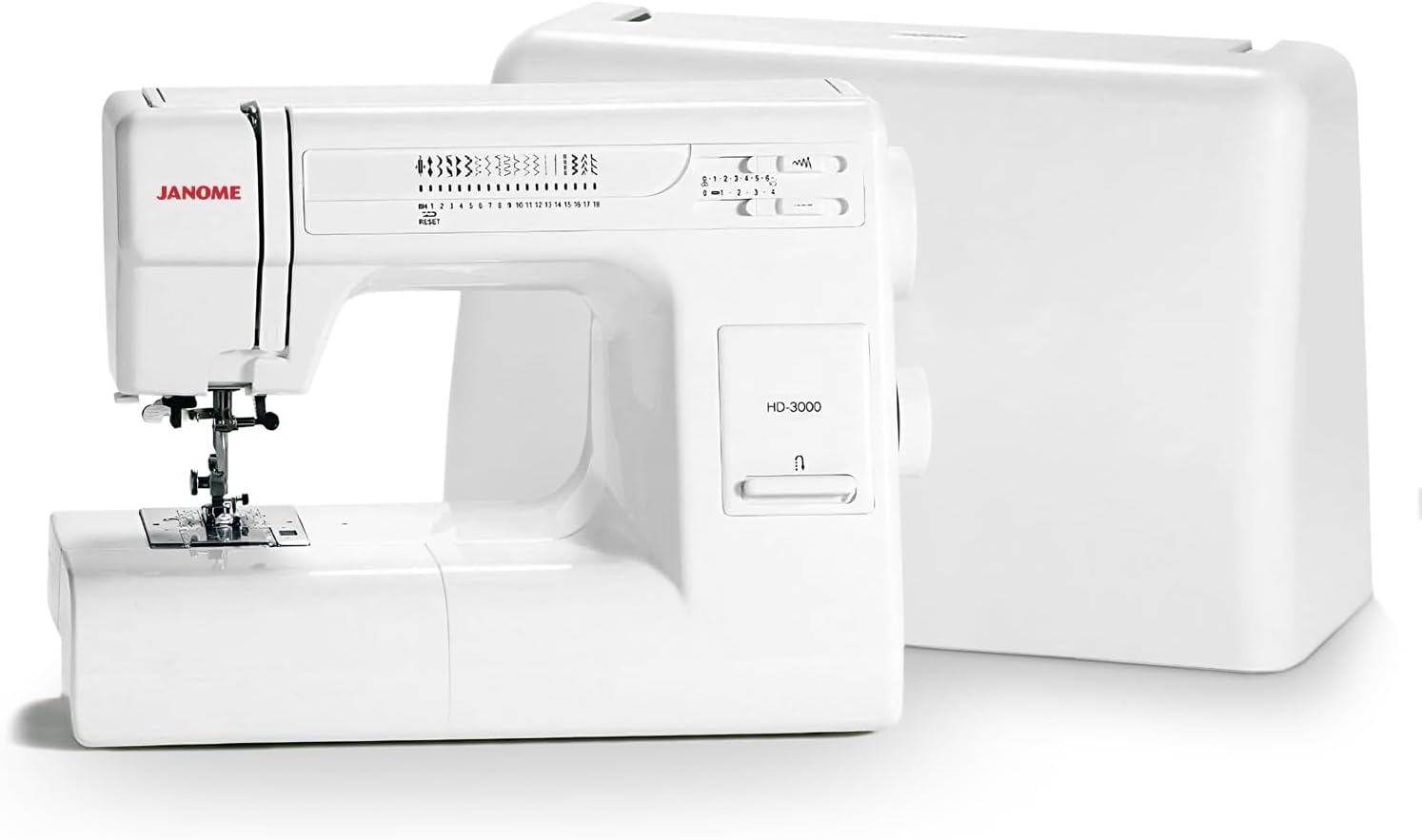
The HD3000 is the machine you buy when you’re done buying machines. Die-cast aluminum body, 18 built-in stitches, one-step buttonhole, built-in needle threader, adjustable presser foot pressure, 5-piece feed dog, extra-high presser foot lift, drop feed for free-motion work, and a hard cover included. It weighs 23 pounds, which tells you everything about its construction. This is a mechanical machine with no computer to fail, no screen to fade, no firmware to glitch, just dials, metal, and a motor.
The use case is specific: heavy fabrics, daily sewing, decades of service. Owners report sewing 8 to 10 layers of denim, upholstery, canvas, and bag-making materials without drama. The adjustable presser foot pressure (missing on every other mechanical machine here) is genuinely useful for switching between quilting cotton and denim. Janome’s stitch quality is superb, and the 25-year warranty backs it.
Street price is usually $470 to $530, hovering right at the $500 line, with the black edition sometimes cheaper. At under $500 it’s an excellent buy. The trade-offs: only 18 stitches (plenty for real sewing, thin for decorative work), 860 SPM (adequate), and 23 pounds (this machine lives where you put it). But if “lasts forever” is the priority, nothing else on this list comes close.
Good
✓ Die-cast aluminum body, the toughest construction on this list
✓ Handles 8–10 layers of denim, genuine heavy-fabric capability
✓ Adjustable presser foot pressure, rare and genuinely useful
✓ Mechanical dials, nothing electronic to fail, built for decades
✓ 18 well-chosen stitches, hard cover included, 25-year warranty
Watch out for
✕ Usually $470–$530, verify it’s under $500 before buying
✕ 23 lbs, this is furniture, not a portable
✕ Only 18 stitches, decorative sewers should look elsewhere
✕ The “one-step” buttonhole is actually multi-step in practice, per owner reports
Bottom line: The last machine you’ll need to buy. If longevity is the priority, this is it.
Skip if: you want computerized features or embroidery, this is deliberately, gloriously mechanical.
What We’d Skip
- Skip buying more machine than your ambition. A $500 machine you use for hems is a $400 waste. Be honest about what you’ll actually sew. The HC1850 at $280 covers 90% of sewers’ real needs.
- Skip the stitch-count trap. The 9960’s 600 stitches are wonderful if you’ll use them and expensive decoration if you won’t. Count the stitches you’ll actually sew, not the ones on the box.
- Skip embroidery machines if you’re “curious.” Embroidery is a separate hobby with its own learning curve, supplies, and frustrations. The SE700 is excellent, but only buy it if embroidery is a goal, not a whim.
- Skip marketplace sellers without checking. The Juki and some Janome listings are sold by third parties. Check the seller rating, return policy, and whether the warranty is honored. A $50 savings isn’t worth a warranty fight.
- Skip ignoring the weight. The HD3000 at 23 pounds and the 9960 at 18 pounds are not portable. If you’ll move the machine regularly, the HC1850 (10 lbs) or CS7000X (13 lbs) are the sane choices.
Comparison Table
| Machine | Type | Stitches | Max Speed | Weight | Buttonhole | Standout Feature | Approx. Price | |
|---|---|---|---|---|---|---|---|---|
| Brother HC1850 | Computerized | 185 | 850 SPM | ~10 lbs | 8 one-step | Best value | ~$280–$300 | Check Price on Amazon |
| Brother CS7000X | Computerized | 70 | 750 SPM | ~13–14 lbs | 7 one-step | Quilting-ready | ~$230–$280 | Check Price on Amazon |
| Juki HZL-LB5100 | Computerized | 100 | 700 SPM | 12.3 lbs | 1-step | 7-point feed | ~$450–$600* | Check Price on Amazon |
| Singer 9960 | Computerized | 600 | 850 SPM | ~14.6–18 lbs | 13 one-step | Lettering | ~$500–$550* | Check Price on Amazon |
| Brother SE700 | Sew + embroidery | 103 + 135 designs | 850 SPM | 15.6 lbs | 10 one-step | 4×4 embroidery | ~$500–$540* | Check Price on Amazon |
| Janome HD3000 | Mechanical | 18 | 860 SPM | 23 lbs | 1-step | Aluminum body | ~$470–$530* | Check Price on Amazon |
*Hovers around $500, regularly dips under during sales. Verify the live price.
Prices fluctuate frequently on Amazon; click through for the current price.
Buying Guide: Spending $500 Wisely
Start from your sewing, not the price tag. The six machines here are specialists disguised as a price tier. The HC1850 is the versatility pick, the CS7000X is the quilting pick, the LB5100 is the precision pick, the 9960 is the decorative pick, the SE700 is the embroidery pick, the HD3000 is the longevity pick. Identify your priority first, then buy the specialist. The wrong $500 machine is worse than the right $280 one.
Computerized vs. mechanical at this price is a real choice. Computerized machines (HC1850, CS7000X, LB5100, 9960, SE700) give you stitch libraries, automation, and convenience. The mechanical HD3000 gives you decades of service with nothing to fail. Neither is better, they’re different philosophies. If you distrust electronics, the HD3000 is your machine. If you love features, go computerized.
The $300 decision. The most important choice on this list isn’t which $500 machine to buy, it’s whether to buy one at all. The HC1850 at $280 and the CS7000X at $250 cover the vast majority of sewing needs. Only spend $500+ for a specific reason: embroidery (SE700), heavy fabrics for decades (HD3000), stitch precision (LB5100), or decorative breadth (9960). “I want a nice machine” is not a specific reason, and the $280 machine is nice.
Watch for sales. Machines at this price discount regularly and deeply. The 9960, SE700, and HD3000 all dip under $500 during major sales. A price alert can save you $50–$100. Never pay full price in a hurry.
What to avoid: overbuying for your ambition, the stitch-count trap, embroidery on a whim, unchecked marketplace sellers, and ignoring weight. A 23-pound machine you need to move is a mistake you’ll feel in your back.
How We Evaluated
We didn’t run a $500-machine shootout in a lab, and we won’t claim we did. Instead, we compared manufacturer specifications across the mid-range category, read owner reviews filtered for long-term satisfaction (2+ years of ownership where available), tracked street prices across sale cycles to verify which machines genuinely sell under $500, and weighted build quality and warranty terms heavily, since at this price the machine should last decades. Scores reward the best match between price, capability, and longevity for each machine’s intended user. Prices shown are typical US street bands; Amazon moves them constantly, so confirm at checkout.
Keep Reading
- Best Sewing Machines Under $200
- Best Sewing Machines for Beginners
- Janome HD3000 vs Singer 4452
- Best Sewing Machines Under $300
FAQs
Is a $500 sewing machine worth it over a $200 one?
It depends on what the $300 buys. For most sewers, no, the $280 HC1850 does nearly everything the $500 machines do. The $500 tier is worth it for specific needs: embroidery, heavy fabrics, precision stitching, or huge stitch libraries. Buy the capability, not the price tag.
What’s the best sewing machine under $500 for quilting?
The Brother CS7000X if you’re budget-conscious (wide table and walking foot included), the Brother HC1850 if you want more stitches, or the Juki HZL-LB5100 if precision piecing is the priority. All three are genuine quilting machines.
Can I get an embroidery machine for under $500?
The Brother SE700 is the cheapest real embroidery machine from a major brand, usually $500 to $540, dipping under $500 on sale. Below that, you’re looking at used machines or toy embroiderers that aren’t worth it.
How long should a $500 sewing machine last?
Decades, with basic maintenance. The mechanical Janome HD3000 is the longevity champion, but computerized machines from Brother, Singer, and Juki routinely last 10–20 years. Clean the lint, change needles regularly, use decent thread, and get it serviced every few years.
Should I buy from Amazon or a dealer?
For Brother, Singer, and the standard Janome models, Amazon is fine, the warranty is the same. For Juki and high-end Janome, consider an authorized dealer, who often includes setup, classes, and in-person service. Dealer prices are sometimes negotiable, it never hurts to ask.
What’s the catch with marketplace sellers?
Some listings (notably the Juki) are sold by third-party marketplace sellers rather than Amazon. Check seller ratings and return policies carefully, and confirm the manufacturer’s warranty applies. A slightly higher price from Amazon direct is often worth the peace of mind.
Verdict
For most upgraders, the answer is the Brother HC1850. At around $280, it’s 90% of the $500 experience for half the money, with 185 stitches, an LCD, and a wide table.
If you quilt, the Brother CS7000X is the budget-conscious pick with genuine quilting capability.
If you’re done buying machines forever, the Janome HD3000 is the last one you’ll need.
And if embroidery is calling, the Brother SE700 is the most affordable real answer.
Spend $500 for a reason, not for a feeling.
Pingback: Best Sewing Machines Under $300 (2026) - sewingmachine.blog
Pingback: Best Sewing Machines for Seniors (2026): 6 Easy-to-Use Picks
Pingback: Singer 9960 vs 9970 (2026): What's Different and Which Should You Buy?