
As an Amazon Associate I earn from qualifying purchases.
Free-motion quilting is the moment a sewing machine stops being a seam joiner and becomes a drawing tool. You drop the feed dogs, snap on a darning foot, and suddenly the needle goes wherever your hands take it. Meandering stipples, feathers, pebbles, whole quilt tops quilted in an afternoon. But here is the catch: not every machine that claims to do free-motion does it well.
The machines that excel at FMQ share a short list of traits. The feed dogs must drop fully out of the way (a darning plate is a compromise, not a solution). There should be real room to the right of the needle, because wrestling a queen-size quilt through a 6-inch throat will test your patience. Speed control matters more than raw speed, since FMQ is about matching needle speed to hand speed. And the machine needs enough power to punch through a quilt sandwich without the motor bogging down on every seam intersection.
This list is built around those criteria. It includes the semi-industrial straight-stitch workhorses that serious quilters swear by, one computerized all-rounder for people who quilt and do everything else too, and a genuine budget pick for quilters who want to try free-motion without spending four figures.
TL;DR: For serious free-motion quilting, the Juki TL-2010Q (~$1,000-1,200) is the machine quilters recommend most: straight-stitch precision, speed slider, and a huge work area. The Brother PQ1500SL (~$750-900) is nearly as fast with a pin-feed system that grips quilt layers. The Janome Memory Craft 6650 (~$1,800-2,100) is the pick if you also want computerized stitches. On a budget, the Brother XR3774 (~$150-200) gets you started.
At a Glance, Our Scores
| Pick | Best for | Our score | Typical price | Buy |
|---|---|---|---|---|
| Juki TL-2010Q | Best overall FMQ machine | 9.6/10, the quilter’s benchmark for straight-stitch FMQ | ~$1,000-1,200 | Check Price on Amazon |
| Brother PQ1500SL | Best for high-speed quilting | 9.3/10, pin feed plus 1,500 spm is a quilt-eating combo | ~$750-900 | Check Price on Amazon |
| Janome Memory Craft 6650 | Best computerized all-rounder | 9.1/10, 10″ throat and 170 stitches for quilters who do it all | ~$1,800-2,100 | Check Price on Amazon |
| Juki TL-2000Qi | Best value semi-industrial | 8.9/10, nearly all of the 2010Q’s muscle for less money | ~$900-1,000 | Check Price on Amazon |
| Janome HD9 Professional | Best heavy-duty FMQ | 8.8/10, 1,600 spm and an industrial hook for thick quilts | ~$1,000-1,300 | Check Price on Amazon |
| Brother XR3774 | Best budget FMQ starter | 8.2/10, drop feed and a wide table at a beginner price | ~$150-200 | Check Price on Amazon |
Prices move constantly on Amazon, every “Check Price on Amazon” link below takes you to the live listing.
Quick Picks
- Best overall: Juki TL-2010Q (~$1,000-1,200).
- Best speed demon: Brother PQ1500SL (~$750-900).
- Best do-everything machine: Janome Memory Craft 6650 (~$1,800-2,100).
- Best budget starter: Brother XR3774 (~$150-200).
1. Juki TL-2010Q

If you ask a room of experienced quilters which machine they free-motion on, a surprising number point at this one. The TL-2010Q is a single-needle, straight-stitch-only machine built like a shrunken industrial: aluminum die-cast body, a motor that holds speed under load, and a top speed of 1,500 stitches per minute. For FMQ, straight-stitch-only is a feature, not a limitation. There is no zigzag mechanism to introduce needle wobble, so the stitches land exactly where you put them.
The details that matter for free-motion are all here. The feed dogs drop with a lever. A speed control slider lets you cap the maximum speed, which is the single most useful FMQ feature a machine can have: set the ceiling, then modulate with the foot pedal so your hands and the needle stay in sync. The automatic thread trimmer (heel-tap on the pedal or the button) saves an absurd amount of time when you are burying threads across a whole quilt. The knee lifter raises the presser foot hands-free, which sounds minor until you are repositioning a heavy quilt every thirty seconds.
Owners report that the machine barely vibrates at speed and sews through thick seam intersections without complaint. The extension table that comes in the box meaningfully expands the work area. Complaints center on the LED lighting being underwhelming and the needle threader taking practice. One honest caveat: it sews one stitch, so if you also want decorative stitches and buttonholes, this is a second machine, not an only machine.
Good
✓ Speed control slider is the best FMQ aid in this price class
✓ Industrial build quality, minimal vibration at high speed
✓ Knee lifter and auto thread trimmer speed up real quilting workflows
✓ Extension table included for a bigger work surface
Watch out for
✕ Straight stitch only, no zigzag or decorative stitches
✕ LED lighting is dimmer than buyers expect
✕ Heavy at nearly 38 pounds, this is a stay-put machine
2. Brother PQ1500SL

The PQ1500SL is Brother’s answer to the TL-2010Q, and the rivalry is friendly because both are excellent. Like the Juki it is a dedicated straight-stitch machine running up to 1,500 spm with an automatic thread trimmer, knee lifter, and a wide extension table in the box. Where it differs is the feed system: in addition to four feed-dog settings, it offers a pin feed mode that swaps the feed dogs for a single pin that drives all quilt layers together. Quilters who sandwich thick batting say the pin feed noticeably reduces layer shifting.
The box is generous: seven feet including a spring-action quilting foot (the free-motion foot), a walking foot, a 1/4-inch piecing foot, and both zipper feet. Buyers consistently praise the stitch quality and the machine’s willingness to sew all day without overheating or complaint. The 25-year limited warranty is a nice backstop at this price.
The trade-offs versus the Juki are small but real. There is no speed control slider on the PQ1500SL, so FMQ speed comes entirely from foot-pedal finesse, which has a steeper learning curve. The bobbin is side-loading rather than drop-in, so checking thread level mid-quilt is less convenient. And some owners find the automatic thread cutter trims tails a touch short, which can unthread the needle if you are not watching. None of these are dealbreakers; they are the reasons this machine often costs a bit less than the Juki.
Good
✓ Pin feed system grips quilt layers better than feed dogs alone
✓ 1,500 spm with auto thread trimmer and knee lifter
✓ Spring-action quilting foot included, ready for FMQ out of the box
✓ Strong warranty and a deep bench of owner support online
Watch out for
✕ No speed control slider, FMQ speed is all in the foot
✕ Side-loading bobbin is harder to monitor mid-project
✕ Thread cutter can trim tails short
3. Janome Memory Craft 6650

Not everyone wants a single-purpose machine. If your sewing life includes garments, home decor, and quilting in roughly equal measure, the Memory Craft 6650 is the FMQ-capable machine that does everything else too. It brings 170 built-in stitches, a 10-inch all-metal throat space, and a 1,000 spm top speed on a heavy-duty aluminum frame. The feed dogs drop for free-motion, there is a speed control slider, and the one-push needle plate conversion lets you swap to the straight-stitch plate in seconds, which genuinely improves FMQ stitch formation.
Owners report that the automatic thread cutter, memorized needle up/down, and superior needle threader make long quilting sessions noticeably less fiddly. The 7-piece feed dog and adjustable presser foot pressure handle everything from single-layer piecing to a thick quilt sandwich. Forum consensus is that Janome’s stitch quality at this tier is superb, and the machine feels planted and quiet.
So why isn’t it ranked higher for FMQ specifically? Two reasons. First, price: it costs roughly double the dedicated straight-stitch machines above. Second, a computerized zigzag machine will never match a dedicated straight-stitch machine for absolute FMQ stitch precision, because the needle bar has lateral play by design. If FMQ is your primary hobby, the Juki or Brother gives you more quilting performance per dollar. If quilting shares the stage with everything else, the 6650 is the one-machine answer.
Good
✓ 10″ throat space handles bulky quilts comfortably
✓ Straight-stitch needle plate swaps in with one push
✓ Speed control slider plus drop feed, proper FMQ controls
✓ 170 stitches for everything beyond quilting
Watch out for
✕ Roughly double the price of the straight-stitch specialists
✕ Slightly less FMQ stitch precision than a dedicated straight-stitch machine
✕ No free arm, which limits some garment work
4. Juki TL-2000Qi
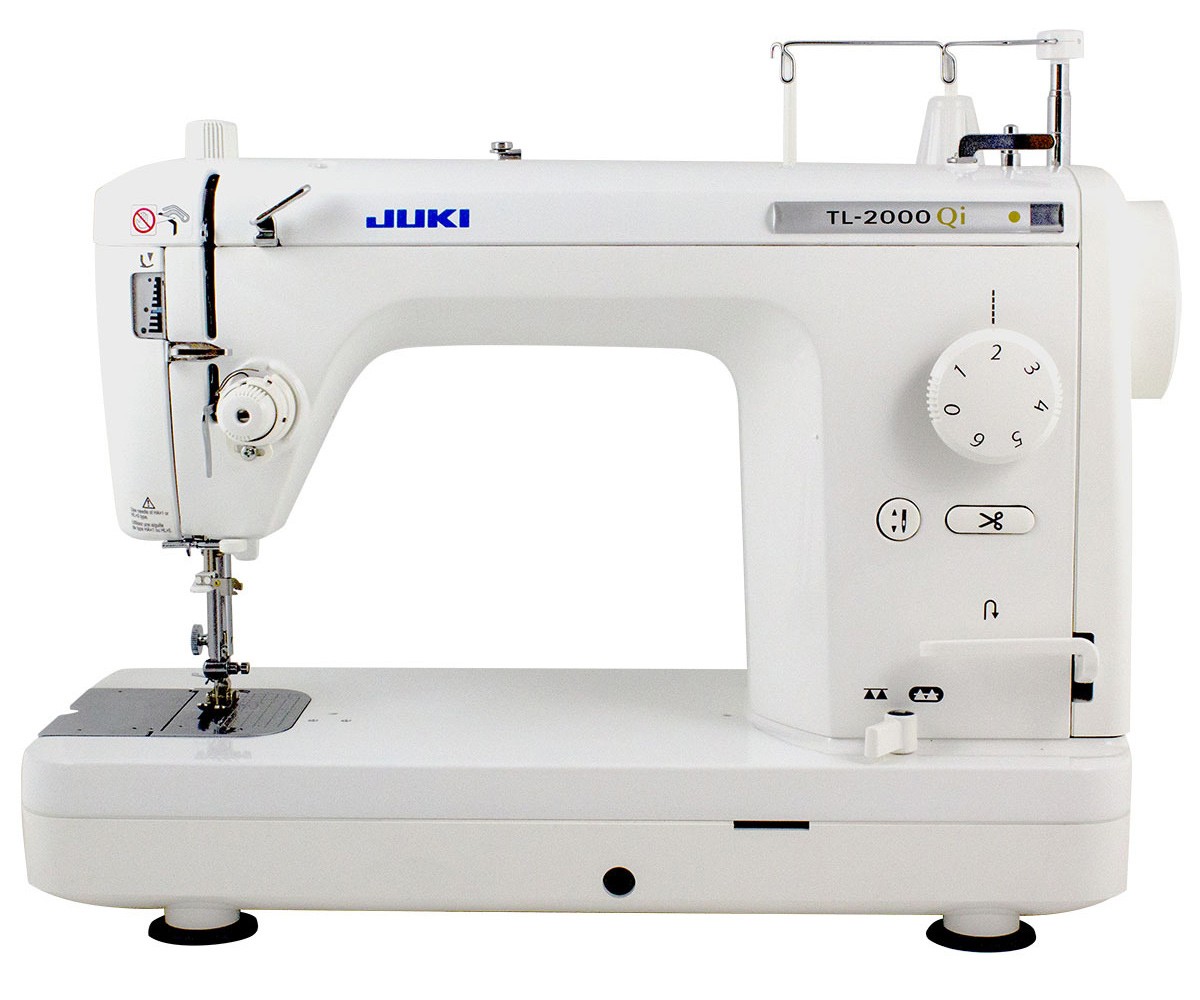
The TL-2000Qi is the TL-2010Q’s slightly older sibling, and the family resemblance is strong: same aluminum die-cast straight-stitch platform, same 1,500 spm top speed, same automatic needle threader and thread cutter, same extension table in the box. For free-motion quilting, it delivers about 90 percent of the 2010Q experience, often for a bit less money.
The meaningful differences: the 2000Qi has no speed control slider, so like the Brother you manage FMQ speed with the foot pedal. It also lacks the 2010Q’s sub-tension system and a couple of refinements. In practice, owners who free-motion on the 2000Qi report the same rock-solid straight stitch and the same ability to chew through quilt sandwiches. The larger industrial-style bobbin means fewer bobbin changes mid-quilt, a small mercy that adds up on big projects.
This is the pick for the quilter who wants Juki build quality and has a good foot-pedal touch, or who plans to upgrade to a 2010Q later and wants the same ecosystem of feet and accessories. One practical note: because it is the older model, availability fluctuates, so if the price gap to the 2010Q is small, take the newer machine.
Good
✓ Same bulletproof straight-stitch platform as the 2010Q
✓ 1,500 spm, auto thread cutter, extension table included
✓ Large bobbin means fewer interruptions on big quilts
✓ Often priced below the 2010Q
Watch out for
✕ No speed control slider, pedal-only speed management
✕ Older model, stock can be inconsistent
✕ Small price gap to the 2010Q erases the value argument
5. Janome HD9 Professional
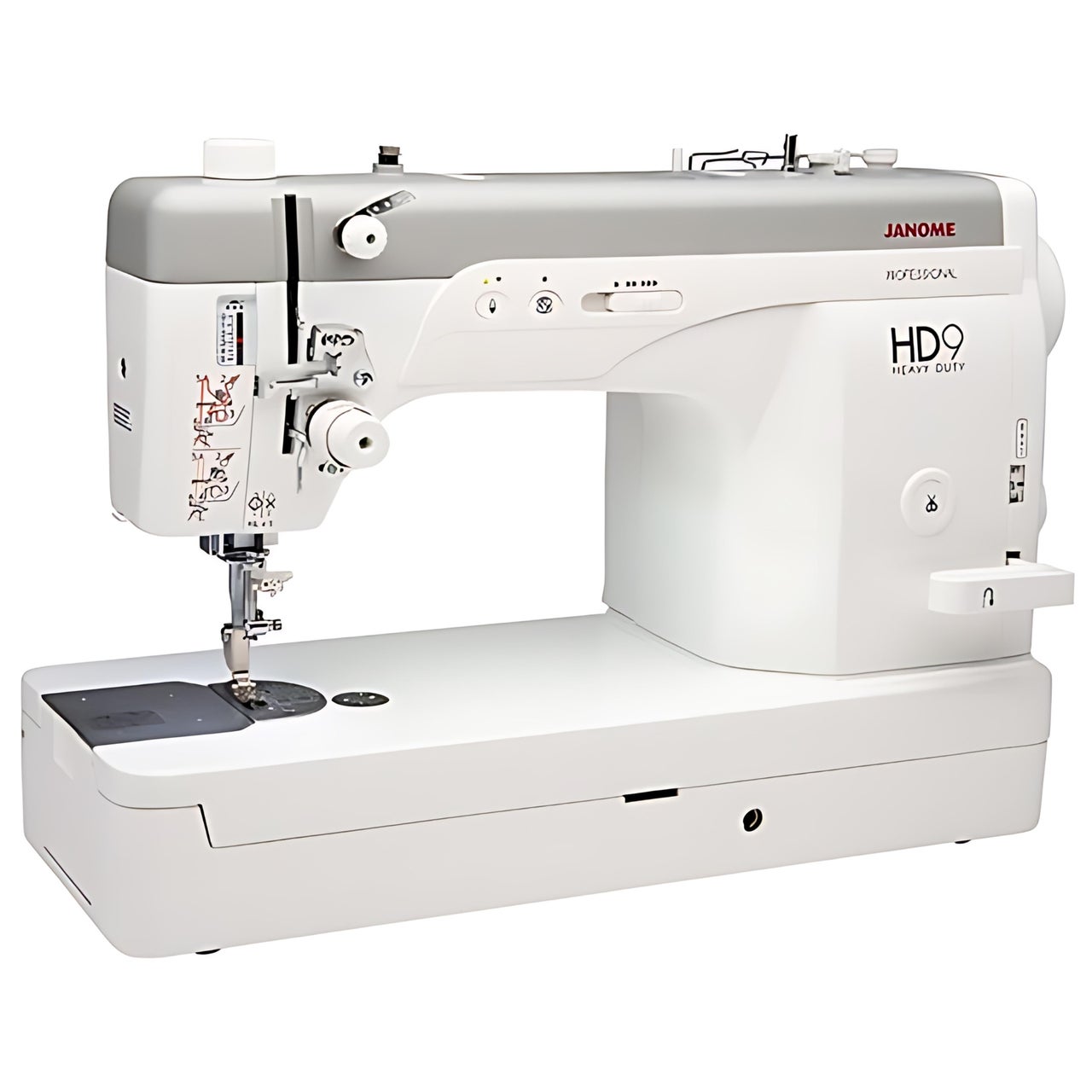
The HD9 is the bruiser of this list. It is a high-speed straight-stitch machine with an industrial-style vertical hook, a side-loading jumbo bobbin that holds roughly 40 percent more thread, and a blistering 1,600 spm top speed. Janome markets it at quilters and home-decor sewists who work with heavy materials, and for FMQ on thick quilts, denim quilts, or quilted jackets, the extra power is genuinely useful.
The bonus bundle commonly sold with the HD9 includes a darning foot and darning plate plus an extra-large extension table, which tells you Janome knows exactly who is buying this machine. The heavy-weight thread guide handles thicker quilting threads that would choke a lesser machine, and up to 11 pounds of presser foot pressure keeps thick sandwiches feeding evenly when you are not in free-motion mode.
Caveats: it takes industrial HLx5 needles rather than standard home needles, which is a minor ongoing hassle. It is heavy and loud compared to the computerized options. And while it is superb at straight-stitch FMQ, it is single-purpose like the Jukis, so budget for that. Buyers who quilt heavy projects say nothing in the home-machine world touches it for power per dollar.
Good
✓ 1,600 spm with industrial-style hook, fastest here
✓ Jumbo bobbin and heavy-weight thread guide for serious quilting thread
✓ Bonus bundles include the darning foot and an XL extension table
✓ Speed control slider for FMQ pacing
Watch out for
✕ Uses industrial HLx5 needles, not standard home needles
✕ Heavy, loud, and single-purpose
✕ Overkill if you mostly quilt standard cotton quilts
6. Brother XR3774

Every quilter starts somewhere, and if you are not ready to spend four figures to find out whether free-motion is your thing, the XR3774 is an honest entry point. It is a mechanical 37-stitch machine with drop feed dogs, a wide extension table, and a quilting foot in the box of eight included feet. That combination, drop feed plus a darning-style foot plus table space, is the minimum viable FMQ kit, and it costs less than a dinner for two.
Set expectations correctly. The throat space is standard home-machine size, so large quilts will be a wrestling match. The motor will not power through thick seam intersections the way the semi-industrial machines do. Speed control is your foot and your foot alone. But owners report that for learning FMQ on placemats, wall hangings, and baby quilts, it does the job, and the machine remains genuinely useful for piecing and general sewing afterward.
Think of this as a low-risk experiment. If you fall in love with free-motion, you will eventually want one of the machines above, and the XR3774 becomes your travel and class machine. If you don’t, you still own a perfectly good general sewing machine.
Good
✓ Feed dogs drop, quilting foot and wide table included
✓ Real FMQ learning platform for under $200
✓ Lightweight and portable for classes
✓ Useful general sewing machine even if FMQ isn’t your thing
Watch out for
✕ Standard throat space, large quilts are difficult
✕ Modest motor bogs down on thick intersections
✕ No speed control slider, all pedal feel
How We Picked
We ranked for FMQ-specific criteria, not general sewing goodness. Every machine here had to have a real feed-dog drop (not just a darning plate), because free-motion with raised feed dogs is an exercise in frustration. We weighted usable throat space, since FMQ lives or dies on how much quilt you can park to the right of the needle. Speed control, whether a slider or excellent pedal response, counted heavily because FMQ stitch quality is a direct function of speed matching. We favored machines with included FMQ-capable feet and extension tables, since buying those separately adds $50 to $150 to the real cost. Finally, we leaned on owner reviews and quilting forum consensus about stitch quality under FMQ conditions, motor behavior on thick sandwiches, and long-term reliability, and we excluded machines with a pattern of tension complaints during free-motion work.
FAQs
Do I need a special foot for free-motion quilting?
Yes. You need a darning or free-motion foot, usually a spring-action open-toe or clear-view foot that hops with the needle and lets you see your stitching line. Most machines on this list include one; for the Jukis it is often in the dealer bundle.
Can I free-motion on a regular sewing machine?
If the feed dogs drop (or a darning plate covers them) and you have the right foot, yes. Thousands of quilters learned on basic machines. The upgrades on this list buy you throat space, speed control, and power, which matter more as your quilts get bigger.
Straight-stitch-only or computerized for FMQ?
For pure FMQ stitch quality, straight-stitch-only wins: no lateral needle play, simpler timing, more power per dollar. Computerized machines win on versatility. Choose based on whether FMQ is your main hobby or one of several.
What is the hardest part of learning free-motion?
Matching hand speed to needle speed. Too fast with your hands and stitches get long and loopy; too slow and they bunch up. A speed control slider helps enormously, which is why it is weighted so heavily in these rankings.
Do I need a walking foot for free-motion quilting?
No, and this is a common confusion. A walking foot is for even feed with the feed dogs up (great for piecing and straight-line quilting). Free-motion requires the feed dogs down and a darning foot instead.
How much throat space do I really need?
For baby quilts and wall hangings, standard space is fine. For throw quilts and larger, every extra inch to the right of the needle noticeably reduces the wrestling. This is why the 10-inch Janome and the wide tables on the straight-stitch machines matter.