
As an Amazon Associate I earn from qualifying purchases.
Every quilting mistake starts at the cutting table. A block cut a sixteenth of an inch off does not look like much until you multiply it across forty blocks and the quilt top ripples. Accurate cutting is the foundation everything else sits on, and the ruler is the tool that makes accuracy repeatable.
If you buy exactly one ruler, make it a 6 by 24 inch rectangle. It cuts strips, squares yardage, trims quilt tops, and handles nearly every straight cut a quilter makes. After that, a small square for trimming blocks and a specialty ruler for your most-cut shape round out a kit that covers years of projects. Based on thousands of buyer reviews and the consistent wisdom of quilting communities, these are the rulers worth owning in 2026.
TL;DR: The Omnigrid 6″ x 24″ (R24) is the one ruler every quilter should own first, the standard for strip cutting for decades. For grip that prevents slipping, the Creative Grids 4.5″ x 4.5″ (CGR4) (~$13-$17) shows off the famous gripper dots. The Fiskars 3″ x 18″ (~$15-$22) is the best value ruler in quilting, and the Creative Grids Stripology XL (~$75-$90) cuts strips faster than anything else.
At a Glance, Our Scores
| Pick | Best for | Our score | Typical price | Buy |
|---|---|---|---|---|
| Omnigrid 6″ x 24″ Rectangle Ruler (R24) | Best overall | 9.5/10, the one ruler to own | ~$25-$35 | ASIN unconfirmed, see note |
| Creative Grids 4.5″ x 4.5″ Square (CGR4) | Best small square | 9.1/10, grip that actually grips | ~$13-$17 | Check Price on Amazon |
| Fiskars 3″ x 18″ Acrylic Ruler | Best value | 8.9/10, cheap, accurate, tough | ~$15-$22 | Check Price on Amazon |
| Creative Grids Stripology XL Ruler | Best strip cutter | 9.3/10, strips in seconds | ~$75-$90 | Check Price on Amazon |
| Omnigrid 12.5″ Square Ruler (R125) | Best for squaring blocks | 9.0/10, the block finisher | ~$28-$38 | Check Price on Amazon |
Prices move constantly on Amazon, every “Check Price on Amazon” link below takes you to the live listing.
Quick Picks
- Best overall: Omnigrid 6″ x 24″ (R24), the standard strip-cutting ruler for generations of quilters, ~$25-$35.
- Best small square: Creative Grids 4.5″ x 4.5″ (CGR4), non-slip grip dots and Turn-a-Round markings, ~$13-$17.
- Best value: Fiskars 3″ x 18″, accurate and nearly indestructible for the price, ~$15-$22.
- Best strip cutter: Creative Grids Stripology XL, slotted design cuts multiple strips without moving the ruler, ~$75-$90.
- Best for squaring blocks: Omnigrid 12.5″ Square (R125), trims finished blocks to perfect squares, ~$28-$38.
Detailed Reviews
1. Omnigrid 6″ x 24″ Rectangle Ruler (R24), Best Overall
This is the ruler. For decades, the Omnigrid 6 by 24 has been the default recommendation in every quilting class, and it earned that position. The patented double sight-lines show up on both light and dark fabrics, the laser-cut edges are smooth and accurate, and the 30, 45, and 60 degree angle lines handle bias cuts and triangles. It cuts strips, trims yardage, squares quilt tops, and does it all with the same ruler.
Quilting instructors consistently recommend beginners start here because every technique book assumes you own one. Owners report buying their first R24 twenty years ago and still cutting with it, which tells you everything about the acrylic quality. If your budget covers exactly one ruler, this is the one, and it is not close.
A note on buying: we could not verify a clean Amazon listing ASIN for the single R24 after repeated searches, so there is no direct button for this pick. Search Amazon for “Omnigrid R24” and you will find it from multiple sellers, or buy it at any quilt shop.
Good
✓ The industry standard 6×24 size handles strips, yardage, and quilt tops
✓ Double sight-lines read clearly on light and dark fabrics
✓ Laser-cut edges are consistently accurate across the whole ruler
✓ 30, 45, and 60 degree lines cover bias and triangle cuts
✓ Legendary durability, owners report decades of use
Watch out for
✕ Smooth back can slip on fabric, some quilters add grip dots themselves
✕ 24 inches long means it needs real table space and careful storage
✕ No Amazon button above, verify the seller when buying elsewhere
✕ The size is overkill for tiny piecing, pair it with a small square
✕ Markings are printed, not engraved, so they can wear with heavy use over years
2. Creative Grids 4.5″ x 4.5″ Square Ruler (CGR4), Best Small Square
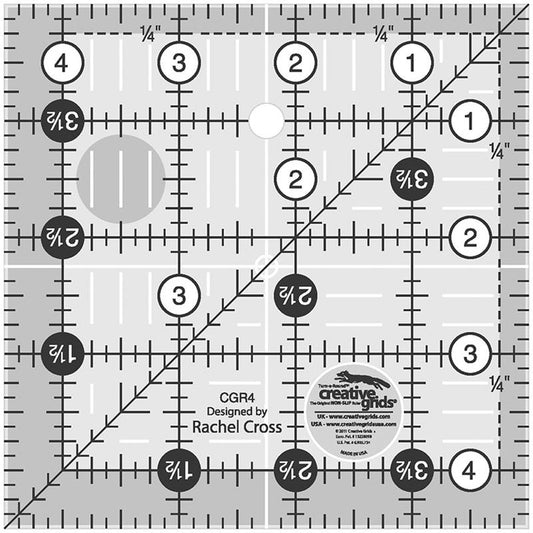
Creative Grids built its reputation on one feature: the gripper dots embedded in the ruler that hold fabric still when you press down and let the ruler slide freely when you do not. Once you have cut with a ruler that does not slip, going back to a smooth ruler feels broken. The 4.5 inch square is the perfect showcase for the system.
This size is the companion to 5-inch charm packs, the most popular precut in quilting. The 45-degree diagonal trims half-square triangles to size, the dashed quarter-inch lines handle seam allowances, and the Turn-a-Round feature lets you cut half-inch increments by flipping the ruler. Owners report it as the small ruler they reach for constantly, for trimming, squaring, and fussy cutting.
Good
✓ Gripper dots genuinely prevent slipping, the standout feature
✓ Perfect size for 5-inch precuts and charm squares
✓ 45-degree diagonal makes trimming half-square triangles easy
✓ Turn-a-Round markings cut whole and half inches without math
✓ Made in USA with precise, easy-to-read markings
Watch out for
✕ Small size limits it to secondary cutting, not strips or yardage
✕ Premium price for a small ruler, you pay for the grip system
✕ The grip dots can collect lint, wipe them occasionally
✕ Only one size here, you will want the 6×24 for big cuts
✕ Black and white markings take a session to learn to read quickly
3. Fiskars 3″ x 18″ Acrylic Ruler, Best Value
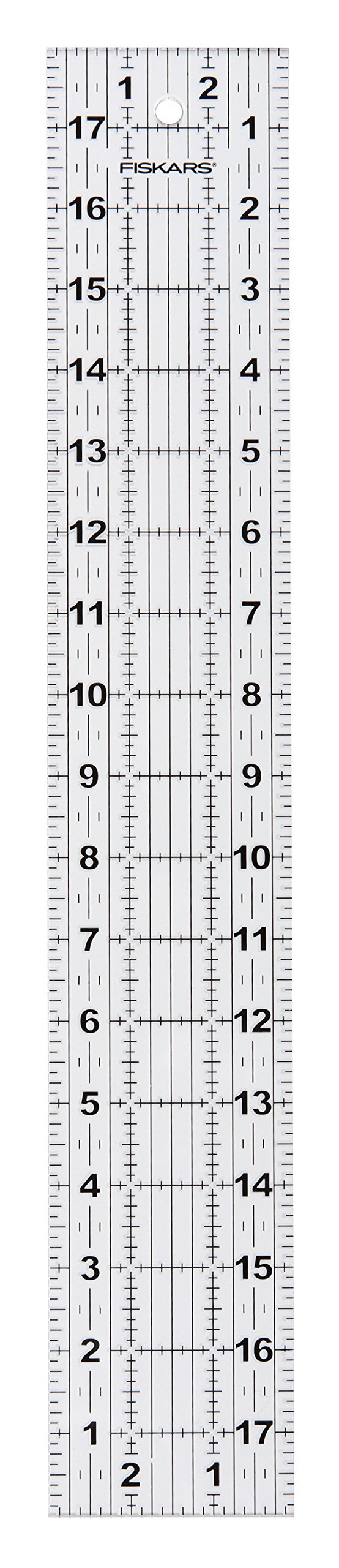
The Fiskars 3 by 18 is the ruler that proves you do not need to spend much to cut accurately. It is thick, clear acrylic with bold easy-to-read gridlines, highlighted seam allowances, and removable non-slip vinyl feet. At this price it is the ruler quilting teachers buy in bulk for classes, which is the strongest possible endorsement.
Owners report it as accurate as rulers costing twice as much, and the Fiskars lifetime warranty backs that up. The 3-inch width is handy for cutting narrower strips and binding, and the 18-inch length handles most cuts short of full yardage width. If you are equipping a beginner or want a second ruler that lives in the travel kit, this is the obvious choice.
Good
✓ Outstanding accuracy for the price, rivals premium rulers
✓ Thick acrylic feels substantial and resists flexing
✓ Highlighted seam allowances speed up common cuts
✓ Removable non-slip feet add grip when you want it
✓ Full lifetime warranty from Fiskars
Watch out for
✕ 18 inches is short for cutting full fabric width in one pass
✕ No angle lines for bias or triangle work
✕ The grid markings are bolder and less fine than premium rulers
✕ Vinyl feet can pop off and get lost
✕ Plain styling, no premium features like grip dots
4. Creative Grids Stripology XL Ruler, Best Strip Cutter
The Stripology XL is the closest thing to a power tool in this roundup. Instead of measuring, marking, and cutting each strip, you lay the slotted ruler on folded fabric and run the rotary cutter through the slots: strips every half inch, with stars marking the 1.5-inch cuts and squares marking the 2.5-inch cuts quilters use most. Owners report cutting a stack of strips in the time it used to take to cut three.
The XL size handles folded yardage generously, and the same ruler squares blocks up to 12.5 inches and cuts 45 and 60 degree angles for diamonds and triangles. It is a real investment at this price, but quilting forums consistently call it the biggest time saver they have bought. If you cut a lot of strips, it pays for itself in an afternoon.

Good
✓ Slotted design cuts perfect strips without measuring each one
✓ Star and square markings highlight the most-used strip widths
✓ Squares blocks up to 12.5 inches, doubling as a square ruler
✓ 45 and 60 degree angles cut diamonds and triangles
✓ Gripper dots hold everything still during fast cutting
Watch out for
✕ Expensive, the priciest ruler in this guide by far
✕ Large and heavy, it needs dedicated storage
✕ Overkill if you rarely cut strips
✕ Works best with a 45mm rotary cutter, small cutters feel awkward in the slots
✕ The size intimidates beginners, watch the included video tutorial first
5. Omnigrid 12.5″ Square Ruler (R125), Best for Squaring Blocks
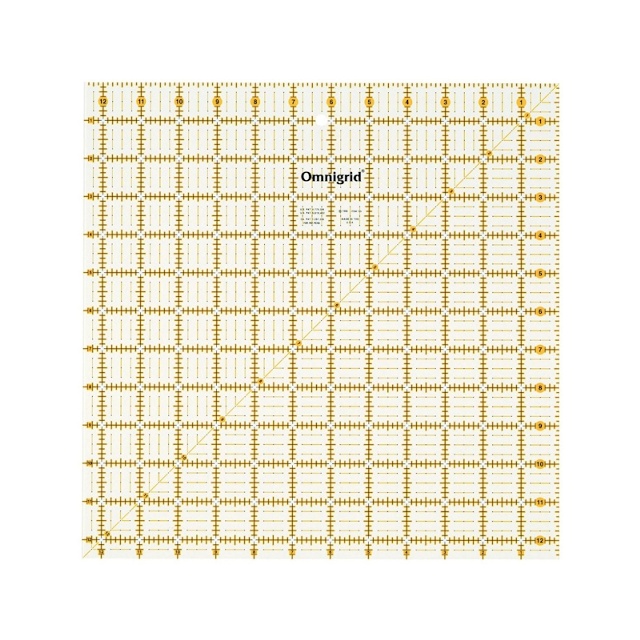
A quilt is only as square as its blocks, and the Omnigrid 12.5-inch square is the tool that makes blocks square. After piecing, you lay the ruler on the block, align the markings, and trim all four sides to a perfect square. Blocks that get this treatment sew together flat. Blocks that skip it fight you at every seam.
The extra half inch is deliberate: it gives you seam allowance room when trimming 12-inch finished blocks, the most common block size in quilting. Owners report it as the finishing tool that visibly improved their quilts, because square blocks make everything downstream easier: sashing aligns, borders fit, and the quilt top lies flat. Pair it with the 6×24 and you own the two most important rulers in quilting.
Good
✓ The right tool for squaring finished quilt blocks
✓ Extra half inch accommodates seam allowances on 12-inch blocks
✓ Same trusted Omnigrid accuracy and double sight-lines
✓ Large enough for most common block sizes
✓ Durable acrylic that survives years of rotary cutting
Watch out for
✕ Single-purpose compared to a rectangle ruler
✕ Smooth back can slip, like the 6×24
✕ 12.5 inches is bulky for small projects
✕ You still need the 6×24 for strips and yardage
✕ No Amazon button issues here, but verify you are buying the R125, not a lookalike
What to Look For When Buying
Start with the 6×24, no matter what. Every other ruler in this guide is a specialist. The 6 by 24 rectangle is the generalist that handles the most common cuts in quilting. Buy it first, learn on it, and add specialists as your projects demand them.
Grip systems are worth real money. A ruler that slips mid-cut ruins fabric and, worse, invites the rotary cutter to go somewhere unplanned. Creative Grids gripper dots, Omnigrip non-slip backing, and even stick-on grip dots all solve the same problem. If your ruler slides, fix the grip before blaming your technique.
Marking readability matters more than marking quantity. The best ruler is the one you can read at a glance. High-contrast markings (black and white, or neon on clear) beat faint etched lines you have to squint at. This is personal, but owners consistently praise rulers they can read quickly.
Acrylic thickness affects accuracy. Thin rulers flex under the pressure of a rotary cutter, and flex means curved cuts. Thick, rigid acrylic stays flat. All five picks here are adequately rigid, which is part of why they are picks.
Match the ruler to the cut. Rectangles cut strips and yardage. Squares trim blocks. Slotted rulers cut strips fast. Small rulers handle small piecing. Buying the wrong shape for your most common cut is the classic beginner mistake, and it is completely avoidable.
Store rulers flat and out of heat. Acrylic warps in hot cars and bends when leaned. A warped ruler cuts curved lines and there is no fixing it. Flat storage on a table or hanging vertically is cheap insurance for tools that should last decades.
Frequently Asked Questions
What is the one quilting ruler I should buy first?
A 6 by 24 inch rectangle, specifically the Omnigrid R24 or its non-slip sibling. It cuts strips, trims yardage, and squares quilt tops. Every quilting class and technique book assumes you own one. Add a small square second and a specialty ruler third.
What is the difference between Omnigrid and Creative Grids rulers?
The core difference is the back surface. Standard Omnigrid rulers are smooth acrylic with excellent printed markings. Creative Grids rulers embed gripper dots that hold the fabric when you press down. Many quilters own both: Omnigrid for the classic feel and price, Creative Grids where slip prevention matters most.
How do I stop my ruler from slipping when cutting?
Press down firmly and evenly, keep the rotary cutter blade sharp (a dull blade needs more force, which pushes the ruler), and consider a ruler with grip dots or a non-slip backing. Stick-on grip dots and ruler handles also help. Cutting on a flat, stable table matters as much as the ruler.
Can I use a metal ruler or yardstick for quilting?
You can measure with one, but do not cut against it with a rotary cutter. Rotary blades skip on metal edges and dull fast. Acrylic quilting rulers are designed with a raised edge that the cutter rides against safely. Keep the yardstick for measuring curtains.
How do I clean a quilting ruler?
Warm water and a soft cloth handle most lint and residue. Avoid harsh solvents, which can cloud acrylic or lift printed markings. If adhesive residue from grip dots builds up, a little rubbing alcohol on a cloth takes it off.
When should I replace a quilting ruler?
When the edge is nicked, the ruler is warped, or the markings have worn off. A nicked edge catches the rotary blade and ruins cuts. With flat storage and normal use, a quality acrylic ruler lasts decades, which is why owners talk about theirs like old friends.